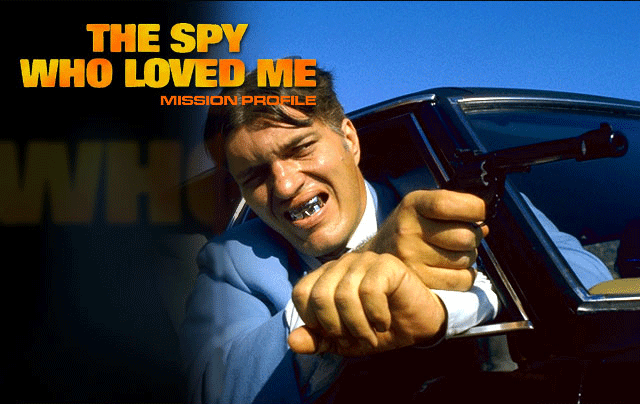
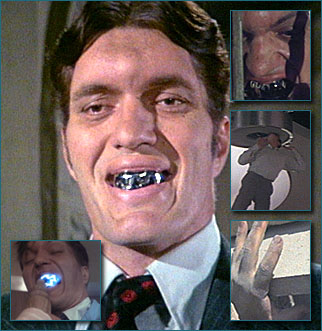
Richard Kiel could only wear the metal teeth for a
few minutes at a time because they hurt so much.
This is Roger Moore's Favorite Bond film.
After the movie's release, requests for the white
Lotus Esprit surged to the point that some people had to be put on 3
year waiting lists.
The villain in The Spy Who Loved Me was
supposed to be Blofeld (along with SPECTRE), but legal wrangles with
Kevin McClory (who was about to embark on the alternate Bond project
Warhead, which later became
Never Say Never Again
1983
) forced Christopher Wood, the screenwriter, to remove any
reference to SPECTRE at the last moment. Stromberg's character was a
direct result of the screenplay changes.
The title is the only part of the original Ian
Fleming novel which was used in the film. When Ian Fleming sold the
film rights, he only sold the right to the title and not the actual
story. This is because the Fleming novel is principally about a female
character with Bond only appearing in the final quarter of the novel.
Fleming felt that as a result the story would not be appropriate for
the film series.
Roger Moore was injured shooting the scene where
Stromberg meets his end. If you look closely at the film, you'll see
Roger Moore's backside/back catch light from where the explosives on
his chair exploded prematurely.
There was a line that 007 should have said
after shooting Stromberg in his private parts. The line was "Ballseye,
Fishfinger", but was deemed too vulgar and obscene. If this line
made it into the final script, an R rating would have been the end
result.
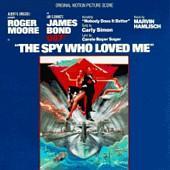
The Spy Who Loved Me CD
Music by Marvin Hamlisch 1977
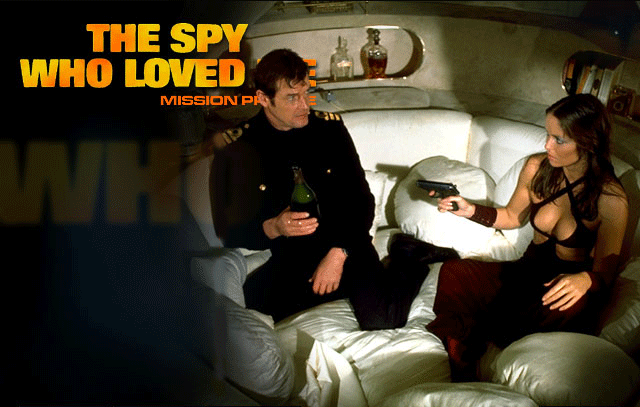
Mission
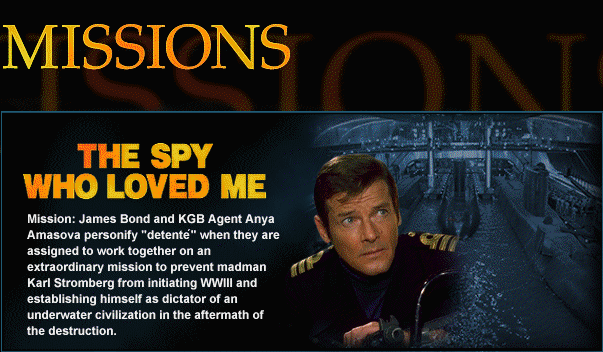
James Bond and KGB Agent Anya Amasova personify "detenté" when
they are assigned to work together on an extraordinary mission to prevent
madman Karl Stromberg from initiating WWIII and establishing himself as
dictator of an underwater civilisation in the aftermath of the destruction.
Nobody does it better than Bond, and he proves it once more in this
explosively entertaining action-adventure! Roger Moore portrays the
immortal action hero with wit, style, and steely determination.
When a massive underwater craft abducts U.S. and Russian submarines,
global tensions are heightened to the brink of war. In order to find the
true culprit, James Bond joins forces with beautiful Russian agent Anya
Amasova (Barbara Bach). Together they follow a trail that leads to Karl
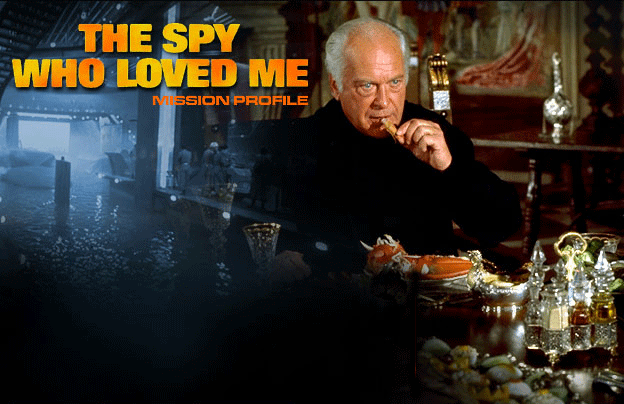
Stromberg (Curt Jurgens), a powerful shipping magnate who is
implementing a horrific scheme for world domination. Bond struggles to
foil the plot, but Stromberg has provided him with a most lethal
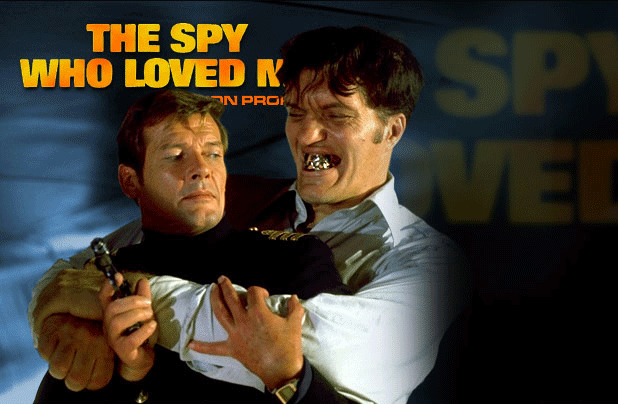
adversary: Jaws (Richard Kiel), a seemingly indestructible steel-toothed
giant. Agent 007's adventure takes him to the Egyptian pyramids, under
the sea and to a mountaintop ski chase that builds to one of the most
amazing stunts ever filmed.
Climaxing with a magnificent, thrill-packed finale in Stomberg's
secret submarine base (which required the construction of the world's
largest soundstage), The Spy Who Loved Me is a relentlessly exciting
action spectacular with romance, humor, and nail-biting suspense.
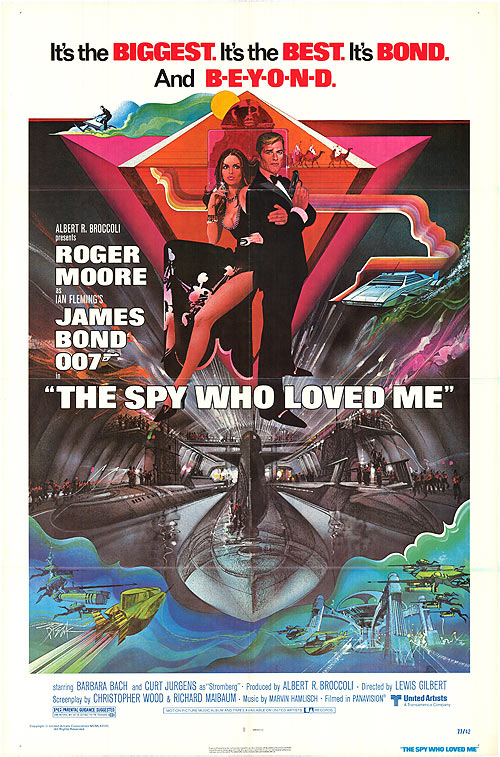
James Bond 007 - The Spy Who Loved Me
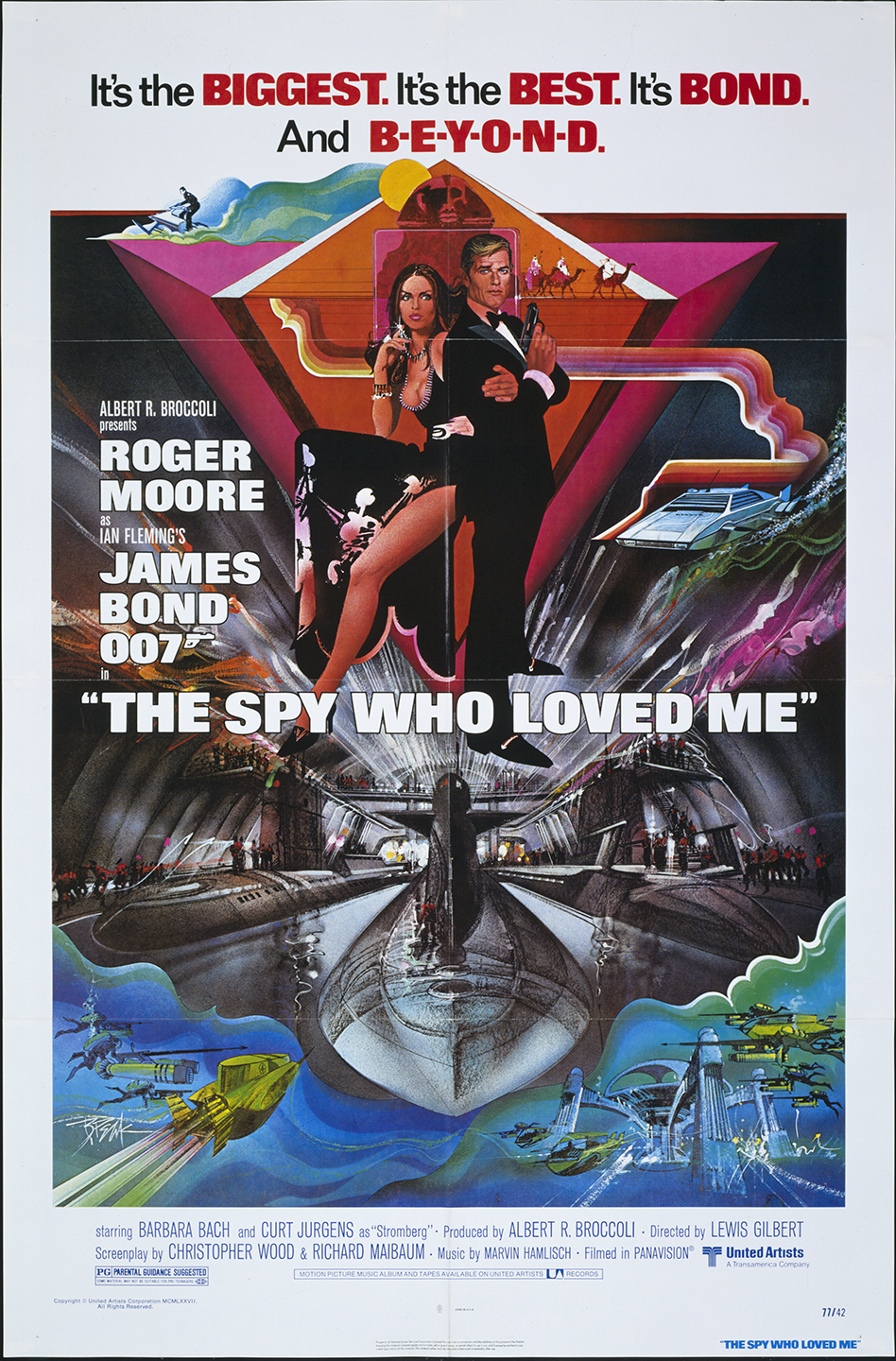
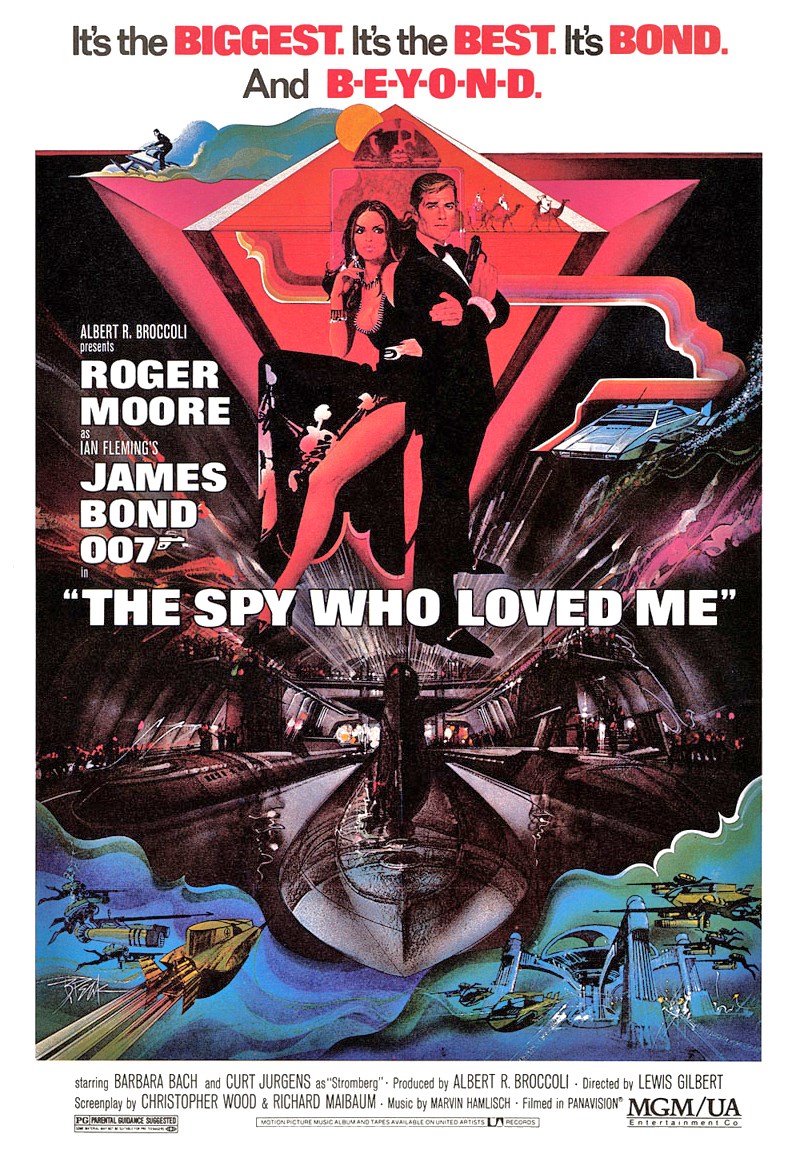
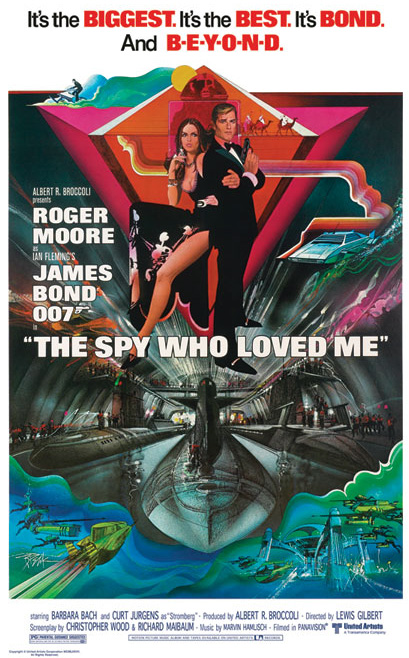
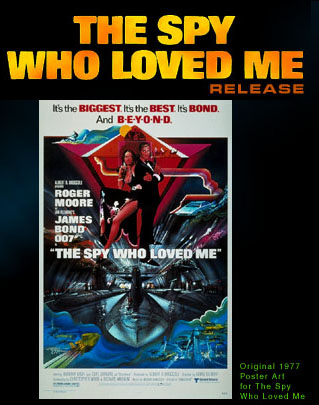
The Spy Who Loved Me posterart
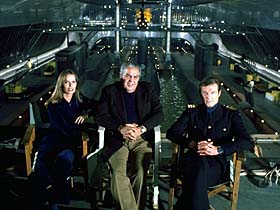
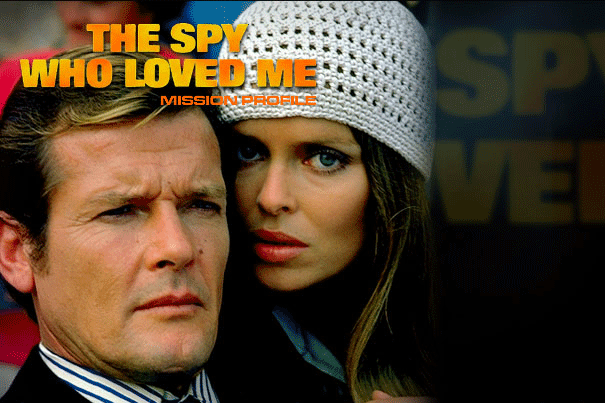
Barbara Bach Albert "R" Brocolli and Roger Moore.
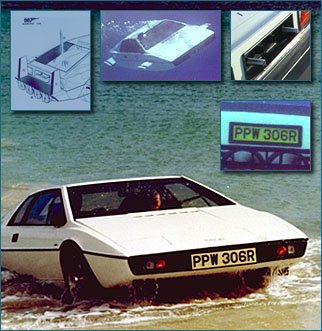
Lotus Esprit from the 1977
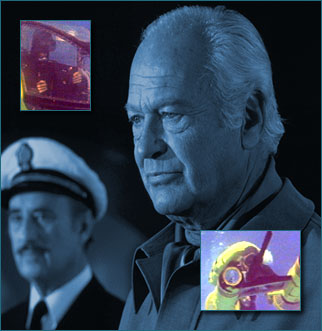
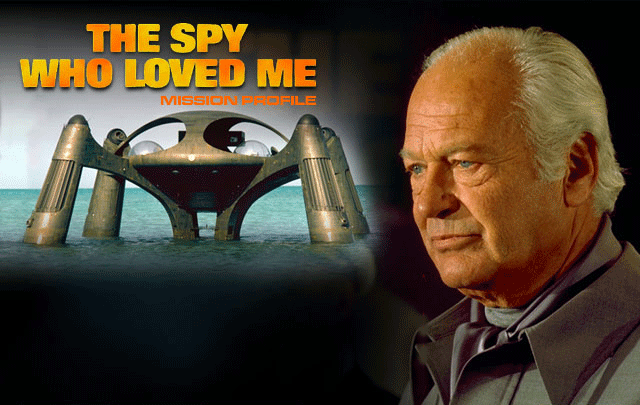
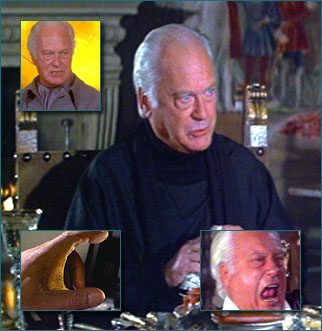
Curt Jurgens as Carl Stromberg
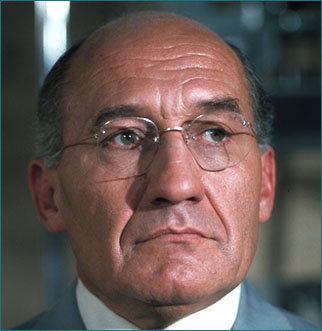
Anatol Gogol
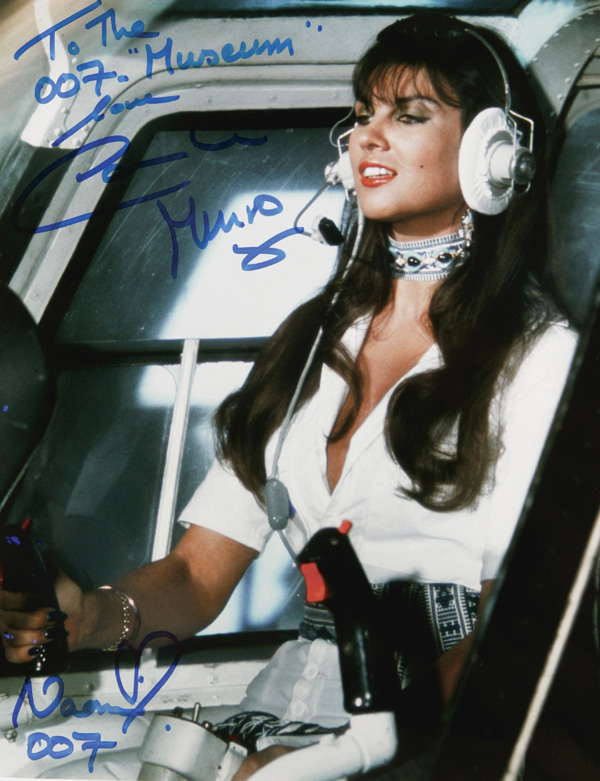
Naomi
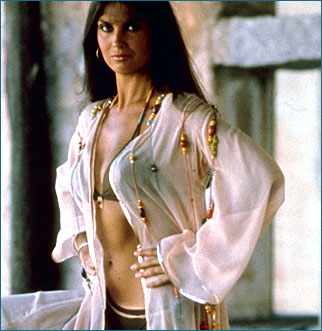
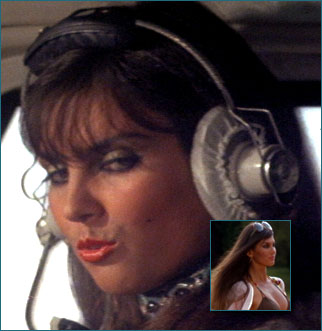
(played by the sexy British actress Caroline Munro),
Naomi (played by the sexy British actress Caroline
Munro),
Film:
Spy who Loved Me, The (1977)
Deceased Character: Naomi (Caroline Munro)
Archetype: Baddy (Minor)
Killed by: James Bond (Roger Moore)
Killed with: Missile
Film: Spy who Loved Me, The (1977)
Deceased Character: Naomi (Caroline Munro)
Archetype: Baddy (Minor)
Killed by: James Bond (Roger Moore)
Killed with: Missile
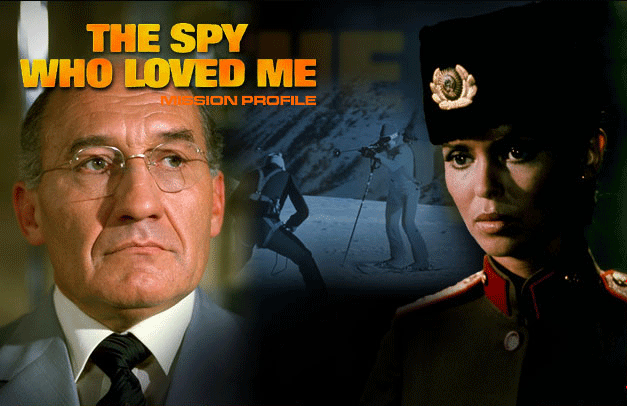
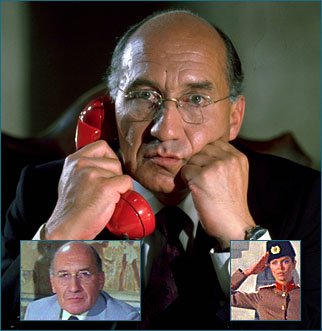
Anatol Gogol Anatol Gogol Played by: Walter Gotell
Curt Jurgens as Carl Stromberg
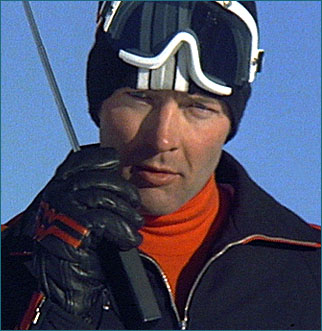
Sergei Barsov : Michael Billington
Naomi
(played by the sexy British actress Caroline Munro)
To The 007 "Museum" from Caroline Munro Naomi love 007
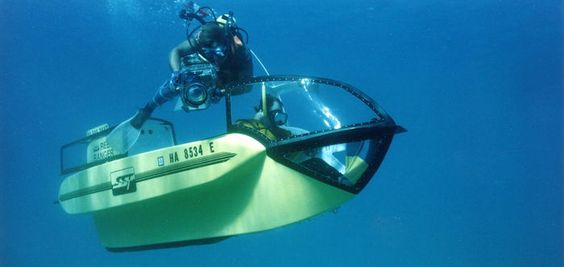
Submersible that appears on 007 films like 'License to Kill'
and 'The Spy who loved me', this submersible is in really mint condition,
A Very Large Prop
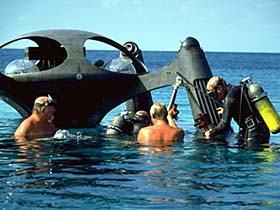
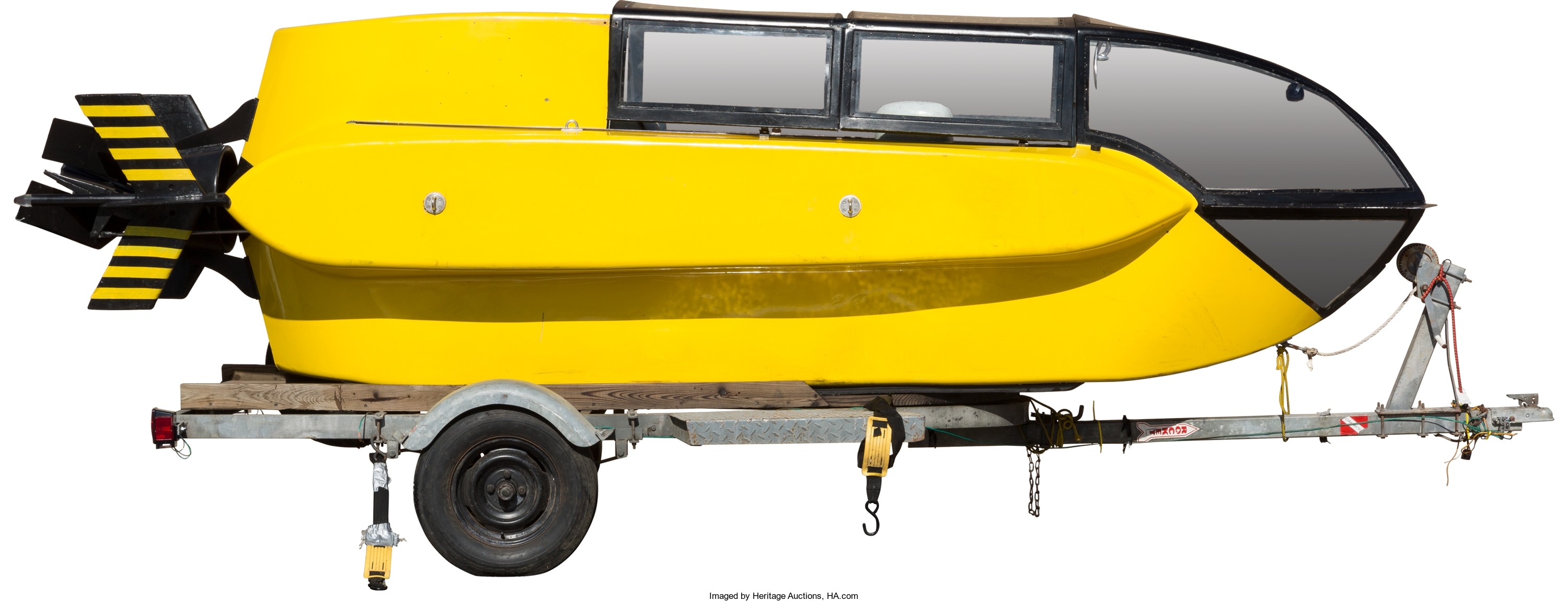
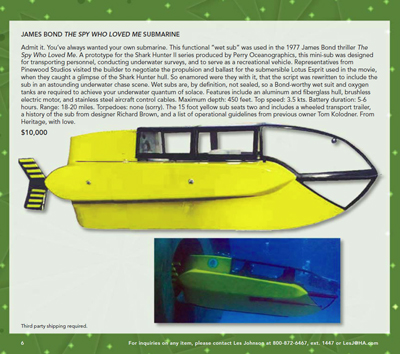
Mini-Submarine from "The Spy Who Loved Me." United Artists, 1977. This
submersible was used in the 1977 thriller starring Roger Moore as "James
Bond." A prototype for the Shark Hunter II series produced by Perry
Oceanographics, this mini-sub was designed to transport personnel, conduct
underwater surveys, and serve as a recreational vehicle. Representatives
from Pinewood Studios visited the builder to negotiate the propulsion and
ballast for the submersible Lotus Esprit used in the movie, when they caught
a glimpse of the Shark Hunter hull. So enamored were they with it, the
script was rewritten to include the sub in an astounding underwater chase
scene. Features include an aluminum and fiberglass hull, brushless electric
motor, and stainless steel aircraft control cables. It does not feature a
pressurized cabin, and thus requires scuba and/or well-developed lungs
during use.
Yellow with black detailing, seats two, and 15 feet in length. Includes
wheeled transport trailer (which has sustained some damage now). Specs at
the time of manufacture were: Maximum depth: 450 feet. Top speed: 3.5 knots.
Battery duration: 5-6 hours. Range: 18-20 miles. Torpedoes: none (sorry).
To view the underwater chase scene from The Spy Who Loved Me
This submarine was used for the underwater chase scenes in
'The Spy Who Loved Me'. It attacks James Bond and
Trible X in their Lotus Esprit submarine.
It is also seen
in two short scenes in 'License To Kill': Stored in
the Wavechrest warehouse. And later leaving the warehouse.
Originally designed by Richard Brown for transporting
personnel, conducting underwater surveys, and for recreation
purposes.
When representatives from Pinewood Studios visited the
builder to talk about the submersible Lotus Esprit details -
they caught a glimse of the Shark Hunter hull. Impressed by
its construction they decided to put it in the movie. The
script was rewritten to include it in the underwater chase
scene.
The vehicle still exists and is operational - on 22.04.2005
the former owner sold this submarine via an Ebay auction for
37.500 USD. In 2006 and 2016 it was on auction again, this
time at Heritage Auction, but still no sale.
The first Bell 206 Jet
Ranger is seen in 'On Her Majesty's Secret Service' where it
brings James Bond disguised as sir Hillery to Blofeld's
hideout 'Piz Gloria' in the Swiss Alps.
In 'Diamonds Are
Forever' the millionaire Willard Whyte has a Jet Ranger in
his assult team.
In 'Live And Let
Die' the Jet Ranger hunts Bond and Solitare through the
Kananga's poppy fields.
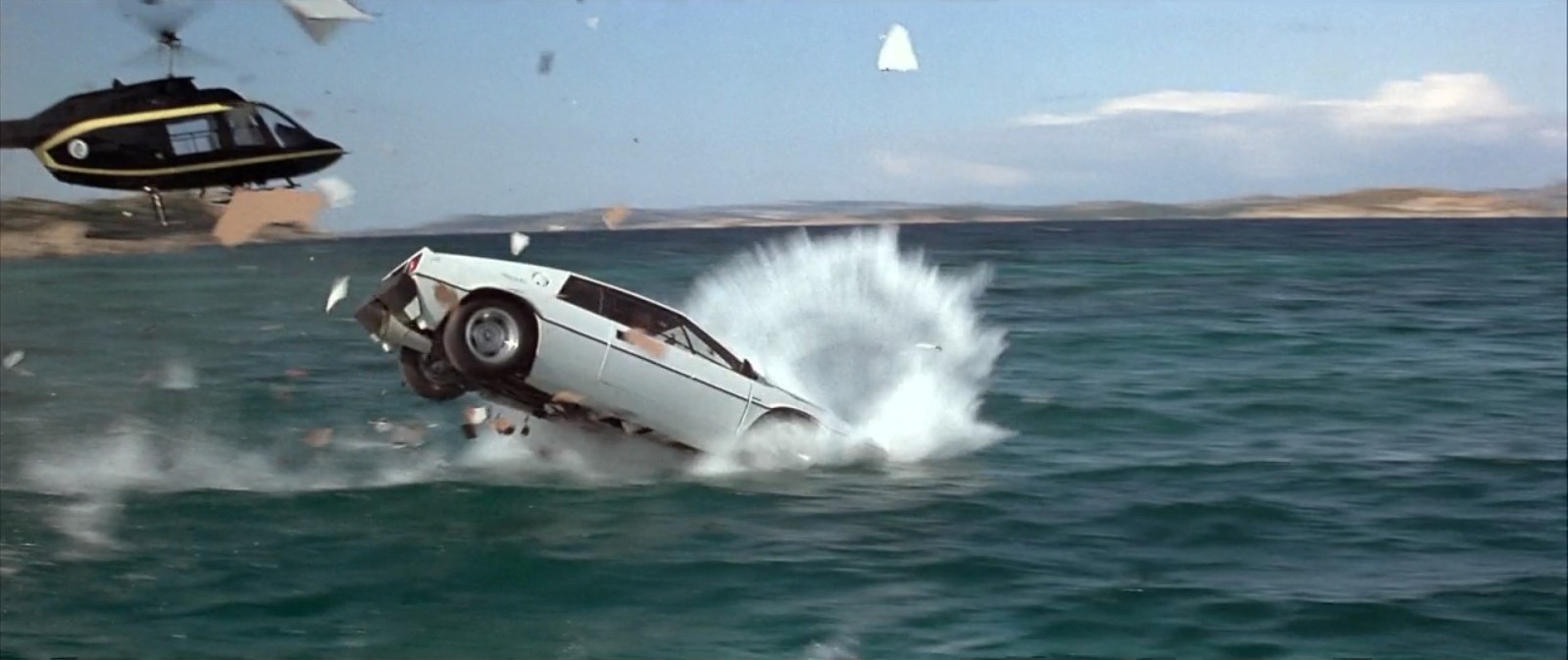
In 'The Spy Who
Loved Me' Stromberg's beautiful pilot Naomi hunts Bond in
the Lotus Esprit.
In 'MoonRaker' the
JetRanger brings Bond to Drax development facility.
In 'For Your Eye
Only's pre-title sequence Blofeld kills the pilot flying
Bond in a 1972 Augusta/Bell 206B. Via radiocontrol Blofeld
tries to kill Bond by flying through a factory. The stunt
pilot was Marc Wolff.
Designed in 1961 as
entry in the US Army Light Observation Helicopter
competition the Bell 206 first flight was in December 1962.
The model was re-designed in 1965 for the civilian light
helicopter market as JetRanger and first flight was January
1966. Several updates has been made, mainly engine
improvements, but also a extended version Bell LongRanger
was produced.
The Bell 206 series
is very popular with more than 5000 build.
007 relation
On Her Majestys
Secret Service (1969)
Villain/henchmens
vehicle
Vehicle Bond
is passenger in
Diamonds Are
Forever (1971)
Allieds/friends
vehicle
Live and Let Die
(1973)
Villain/henchmens
vehicle
The Spy Who Loved
Me (1977)
Villain/henchmens
vehicle
Vehicle Bond
is passenger in
Persuers
vehicle
To The 007 "Museum" from Caroline Munro Naomi love 007
Moonraker (1979)
Villain/henchmens
vehicle
Vehicle Bond
is passenger in
For Your Eyes Only
(1981)
Villain/henchmens
vehicle
Vehicle Bond
drives
Vehicle Bond
is passenger in
Technical data
Manufacturer:
Bell Helicopters Textron (USA)
Helicopter:
Bell OH-58C Kiowa
Year: 1976
Engine: 420
shp Allison T63-A-720
Rotor
diameter: 10,77 m (35 ft 4 in)
Fuselage
length: 9.93 m (32 ft 6 in)
Overall length:
12,49 m (41 ft)
Height: 2,91 m
(9 ft 6 in)
Empty weight:
825 kg (1.818 lb)
Gross weight:
1.451 kg (3.200 lb)
Maximum speed:
222 km/h (138 mph)
Hovering
ceiling IGE: 4.025 m (13.200 ft)
Service
ceiling: 5.640 m (18.500 ft)
Range: 480 km
(298 miles)
Capacity: 2
pilots + 3 passengers
The Spy Who Loved Me (1977)
helicopter Jet Ranger and Lotus Esprite
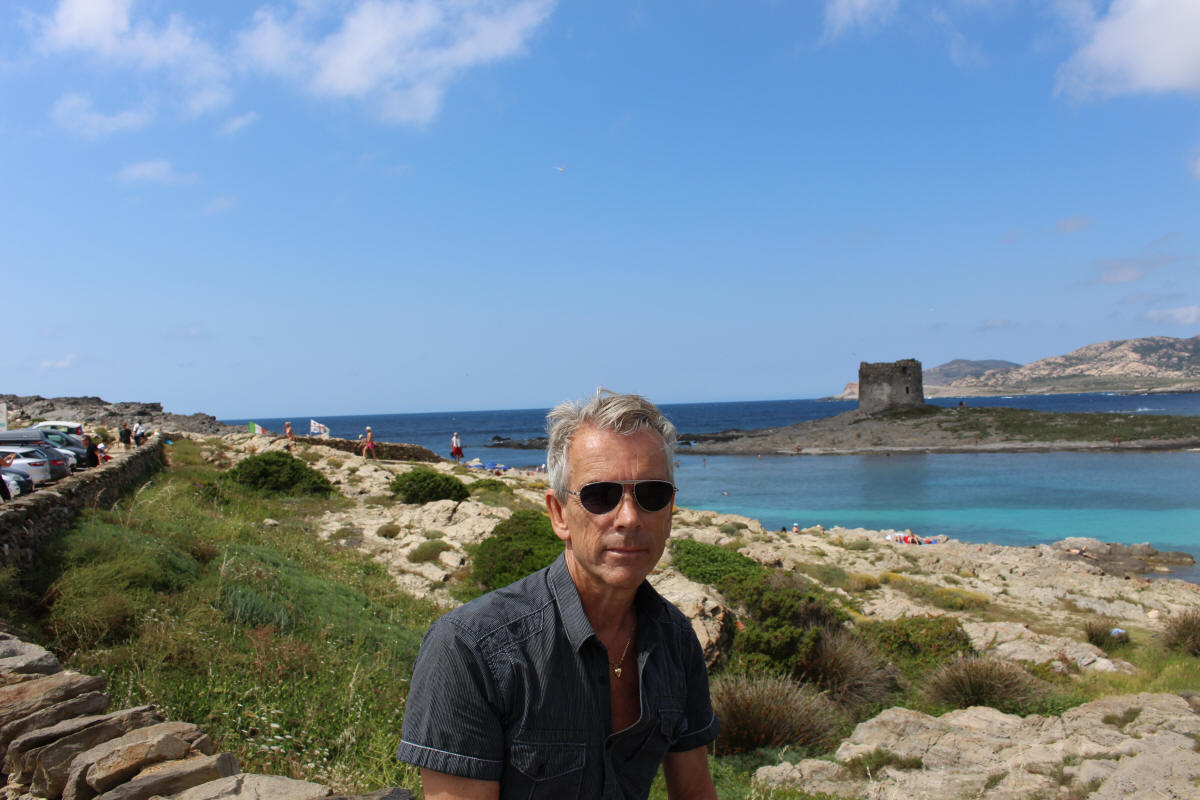
La Pelosa i Stintino
Sardinia,, beach James Bond The Spy Who Loved Me 1977
Trivia - The Spy Who Loved Me
Production
This is the only Eon Productions James Bond movie to be
made in the same order as its source novel was written. The Spy Who Loved Me was
both the 10th official series James Bond movie produced and the 10th Ian Fleming
James Bond novel written.
Harry Saltzman sold his interest in
James Bond during December 1975 while this movie was in pre-production. Though
the last James Bond movie which was co-produced by Harry Saltzman and Albert R.
Broccoli was The Man with the Golden Gun (1974), the dissolution of the
partnership did not occur until after that film was released. Saltzman was
actually involved with the The Spy Who Loved Me (1977) during early
pre-production of the film, as was the original director Guy Hamilton.
A number of writers contributed to the
script during its development. These included directors John Landis and original
director Guy Hamilton; script writers Richard Maibaum, Stirling Silliphant, Cary
Bates, Tom Mankiewicz and Anthony Barwick; and authors 'Anthony Burgess' ,
Ronald Hardy and Derek Marlowe. In total, twelve scriptwriters worked on the
script which went through to fifteen drafts.
Screenwriter Richard Maibaum's original
draft of The Spy Who Loved Me (1977) featured an alliance of international
terrorists entering SPECTRE's headquarters and deposing Blofeld before trying to
destroy the world for themselves to make way for a New World Order. This script
was deemed too political by producer Albert R. Broccoli.
Gerry Anderson (creator of "Thunderbirds"
(1965)) threatened legal action against the producers as he felt the film came
too close to a story proposal he had offered the Bond producers in the 1960s.
The suit was dropped, though EON Productions ended up purchasing the rights to
Anderson's original proposal.
The delay in production of this movie
was contributed to by legal issues to do with the script. Thunderball (1965)
co-writer and producer Kevin McClory brought a suit against the production
stating that his script "Warhead" had been allegedly plagiarized. This
was due to the similarity in story-lines involving nuclear submarines. The
injunction was ultimately rejected and EON productions could proceed. However,
the original name of the villain was changed from Stavros to Stromberg, due to
the similarity between Stavros and the middle name of Ernest Stavro Blofeld, the
use of this character legally belonging to McClory. Interestingly, apparently in
a very early version of the script, it was intended to have Blofeld return as
the villain.
Several scenes, including the one where
Bond and Anya meet each other in a Cairo bar, were written by an uncredited Tom
Mankiewicz. According to him, the scene originally made reference to Tatiana
Romanova, the Bond girl in From Russia with Love (1963), but this was cut. If it
had been left in, the film would have included direct references to both the
Sean Connery and George Lazenby eras of the Bond series.
Product placements and promotional
tie-ins seen in the movie included BOAC, Lotus Cars, Bacardi, and Jetski
Wetbikes.
Vehicles featured included a white Lotus
Esprit S1 turbo sports car adaptable Perry submarine-car, which was also known
by the production as Margie Nixon and Wet Nellie; a Arctic Enterprises Wetbike
hydrofoil water motorcycle; Jaw's Telephone Service gray Sherpa Van; a yellow
and black Kawasaki Z900 motorbike with sidecar; Hovercraft Speedboat jettisoned
from Atlantis; a black and yellow Shark Hunter mini-submarine; a black and
yellow Bell 206 Jet Ranger helicopter; black Ford Taunus car; the Liparus oil
tanker which includes a Mini Moke; Westland HH-3 Sea King and Westland Wessex HC
Mk 2 helicopters; 1977 Ford Cortina 2.3 Ghia; USS Wayne and Russian Potemkin
Submarines; a Stromberg Enterprises company motorboat; a small bus and a
spherical underwater escape pod from Atlantis.
Introduced a spy sea scooter known as a
"wetbike" (better known now as a jet ski) to the world, sparking a new
water-sport industry. This gadget was commonly referred to as the motorbike that
rides on water.
In his audio-commentary, Roger Moore
comments on the opening parachute ski-jump that could have gone horribly wrong
for stuntman Rick Sylvester. After the jump, a disengaged ski clipped the
unopened chute as it was falling. The ski could could easily have prevented the
chute from opening. It can still be seen in the final footage that the ski clips
the about-to-open parachute. Rick Sylvester was paid $30,000 for the skiing
stunt in the opening sequence.
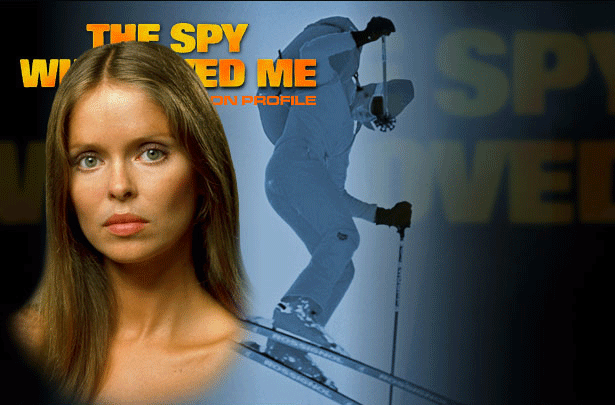
An advertisement inspired the famous
opening skiing sequence. It was for Canadian Club Whisky and featured Rick
Sylvester jumping off Asgard in Greenland. The ad had actually been staged
elsewhere and had really been performed off the El Capitain Peak, Yosemite
Valley, California. The ad read: "If you Space Ski Mount Asgard...before
you hit the ground, hit the silk!". Sylvester performed the stunt for the
film which famously ended with a parachute of the Union Jack opening. This
opening sequence was recently parodied in Bridget Jones: The Edge of Reason
(2004) and was imitated with the air balloon in Octopussy (1983) and paid homage
to in the Gustav Graves parachute drop in Die Another Day (2002). Sylvester also
did the Meteora mountain fall in For Your Eyes Only (1981).
The famous Union Jack parachute ski jump
stunt during the film's pre-title sequence was (reportedly) originally suggested
by former Bond star George Lazenby to be used in On Her Majesty's Secret Service
(1969), but the necessary equipment to film it was not available then.
First James Bond movie to feature an
actor playing James Bond to appear as part of the opening titles sequence itself.
In On Her Majesty's Secret Service (1969), footage from previous films including
an actor playing James Bond was edited into the opening sequence.
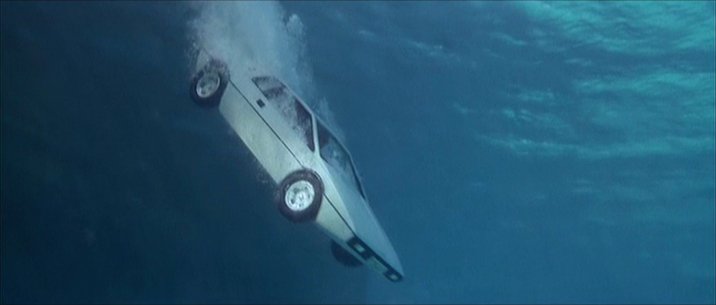
The Lotus submersible (the Lotus Esprit
underwater car or Lotus submarine car) was code named Esther Williams in an
early draft of the script and was also nicknamed by the crew as Wet Nellie
(after the mini-helicopter in You Only Live Twice (1967)). It is called Wet
Nellie in the novelization.
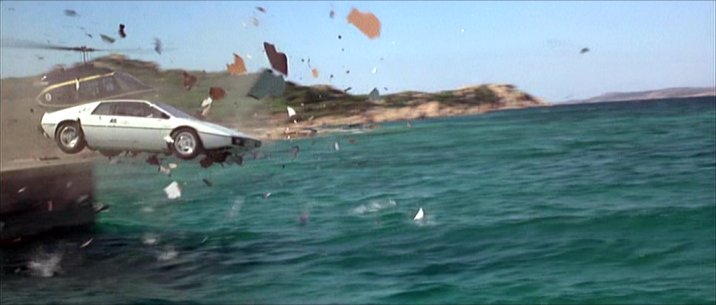
The chase sequence in Sardinia involving
the Lotus Esprit runs for seven minutes.
After the film's release, demand for
white Lotus Esprit cars surged to the point that new customers had to be placed
on a three-year waiting list.
The Aquapolis, the enormous Japanese
floating sea structure, was considered as an exterior set for the Stromberg
Marine Research Laboratory, Atlantis. It resembled an oil rig (something which
had already been used in Diamonds Are Forever (1971)), had a gigantic
three-tiered deck which was also a helicopter pad measuring 100 m2, and was
supported by about a dozen major pillars. It cost 13 billion yen and had been
built in Hiroshima in 1975 then transported to Okinawa for the International
Ocean Exposition. Depending on weather conditions, it could partially rise or
submerge into the ocean, in a similar fashion to the Atlantis setting of the
movie's script. At the time of the location scout, it was incomplete and after
attempts to make the mega-structure work, production designer Ken Adam felt that
it lacked the right creative elements for the nautical villain's lair.
Disappointingly, the floating sea city was rejected as an exterior location for
Atlantis and the filmmakers decided to go with a model. Sadly, it was closed to
tourist visits in 1993 and in 2000, after twenty-five years, the real-life
floating city in the ocean was sold for scrap after the company that owned it
went bankrupt.
During the Egyptian shoot, the catering
didn't arrive. Producer Albert R. Broccoli jumped into action and took a jeep
and some crew, went into town and got some tomatoes, pots, pans and pasta was
flown in from Cairo. Broccoli, well known as an amateur chef at home, cooked up
a feast for the cast and crew, served by him and Roger Moore. A sign was painted
in the mess-room: "Trattoria Broccoli."
In one scene amongst the pyramids when
Jaws is trailing a hiding agent 007, a still photograph of Roger Moore was used
when they needed to have him in the shot. Hardly anyone noticed this during the
film's release. Further, all the shots of pyramids used were actually models.
The eyesight of cinematographer Claude
Renoir was failing at the time and he could not see to the end of the massive
supertanker set. As a result, he could not supervise the lighting. Ken Adam
turned to his friend Stanley Kubrick, who under the condition of complete
secrecy supervised the lighting.
$1 million of the $13.5 million budget
was spent by production designer Ken Adam on building the largest sound stage in
the world: 336'x139'x44'. The set was used for the interior shots of Stromberg's
supertanker. The tank had a capacity of 1.2 million gallons.
The set for Stromberg's supertanker was
named "the Jonah Set", in reference to the Biblical story of Jonah,
who is swallowed by a whale. In the film, the tanker swallows submarines.
The date the new OO7 Stage was opened
and christened at Pinewood Studios was 5 December 1976, coinciding with the
production of this movie. Former English Prime Minister Harold Wilson, Roger
Moore and Barbara Bach partook in the opening ceremonies for the stage which was
first used for the production of this movie.
The literal translations of some this
film's foreign language titles include The Spy That Loved Me (Spain, Norway,
France, Denmark); 007, My Beloved (Finland); The Spy That I Loved (Portugal);
Beloved Spy (Sweden); The Spy That Loves Me (Poland) and 007, The Spy Who Loved
Me (Brazil)
The title song "Nobody Does It
Better" sung by Carly Simon and composed by Marvin Hamlisch was a hit in
both the USA and UK. The song was so successful that the title "Nobody Does
It Better" has become part of James Bond universe phraseology. It charted
in the USA on 23 July 1977 and went to No. #2. It stayed there for three weeks
and was in the US charts for 25 consecutive weeks. It entered the charts in the
UK on 6 August 1977 and peaked at the No. #7 position. The song in the USA also
achieved the classification of being a Gold Single. The soundtrack album charted
in the USA on 27 August 1977 and went to the No. #40 rank.
A piece of music composed by Mozart
inspired the title song 'Nobody Does It Better" composed by Marvin Hamlisch.
Indeed, the film includes in its score a number of pieces of classical music by
such composers as Johann Sebastian Bach (Air in Orchestral Suite No. 3, BWV
1068), Frédéric Chopin (Nocturne No. 8 in D-Flat, Op. 27 No. 2), Camille
Saint-Saëns (The Aquarium from The Carnival of the Animals) and also by
Wolfgang Amadeus Mozart, the Andante second movement of Piano Concerto No. 21
Elvira Madigan. These pieces of music however are not on the movie's soundtrack
album.
The movie received Three Academy Award
Nominations - the most ever received by a James Bond movie to date. These were
for Best Art Direction - Set Decoration, Best Score, and Best Song - "Nobody
Does It Better".
Albert R. Broccoli once named this film
along with From Russia with Love (1963) and Goldfinger (1964) as his three
favorite James Bond movies, according to an interview with the Hollywood
Reporter's Robert Osborne on 12 April 1982.
The Spy Who Loved Me location: Cala De Volpe, Sardinia
Before heading off to Stromberg’s underwater hideout, Bond and Amasova stay at
the huge Hotel
Cala di Volpe, Costa
Smeralda, perched, like a faux-Mediterranean village, atop the cliffs on
the north coast of Sardinia. Sadly, you can’t check
into Bond’s room – this was actually the hotel’s Piano Bar.
The
second-largest island in the Mediterranean (after Sicily), Sardinia is
part of Italy,
and has three international airports. Olbia
Costa Smeralda Airport, the second largest, is
about two miles away from the city centre of Olbia.
The road chase is on a
stretch of coast road at Vista Point, on the SP94 about
a mile south of the hotel, and on the small piazza of San
Pantaleone, to the southwest. Bond’s submersible Lotus Esprit finally
comes ashore on the beach at Romazzina, on the coast
east of the Cala di Volpe.
Story
First James Bond movie to be filmed in Dolby Stereo.
The original M's first name is heard for the only time in the
film series when Gogol refers to him as Myles (in the books, his name was
Admiral Sir Myles Messervy and was only ever mentioned in the novel "The
Man With The Golden Gun"). In addition, Bernard Lee's M calls Bond by his
first name for only the second time in the series - the first time was in On Her
Majesty's Secret Service (1969). The last time Q was referred to by his real
name (Major Geoffrey Boothroyd) was in Dr. No (1962) and From Russia with Love
(1963).
James Bond and Anya Amasovas' aliases when they first visited
Atlantis were Mr and Mrs Robert Sterling.
First Bond film to make significant references to Bond's past,
including his recruitment to the British Secret Service from the Royal Navy, his
"many lady friends", his marriage and the death of his wife, Tracy.
During the fight scene at the Pyramids between Bond and two
KGB agents, Bond at one point delivers a blow that causes one of the men to, in
reflex, cross his arms over his chest, making him resemble a character in old
Egyptian drawings.
The hull number on the sail of the U.S. submarine USS Wayne
in Stromberg's supertanker is 593. This is the number of the USS Thresher, lost
in 1963 with all hands off the Massachusetts coast.
The license plate number of the Lotus Esprit was PPW 306R.
A Minolta logo appears on the microfilm capsule.
Anya's music box-transmitter plays Lara's Theme from Doctor
Zhivago (1965).
After the van breaks down, the theme from Lawrence of Arabia
(1962) plays when Bond and XXX walk across the desert.
Russian Agent Anya Amasova's code number was XXX (i.e. as in
Agent XXX). Anya's henchmen in Egypt were called Ivan and Boris.
The name of Max Kalba's club in Cairo, Egypt was the Mujaba
Club.
A fight sequence was originally envisaged in this movie for
the Mummy Room of the Cairo Museum of Antiquities. This was scrapped but the
sequence resurface in the next Bond movie Moonraker (1979) as the fight between
Chang and Bond in the Venini glass showroom.
The Lotus Esprit underwater spy car had the following
features and gadgets: A periscope; convertible dashboard-control panel; oil
release, harpoon and cement guns; retractable turning wheels; hydroplanes;
protective louvres; television monitor; rudder and propulsion units; submarine
activator; rocket missiles and missile firing control.
The two stolen nuclear submarines were the American "USS
Wayne" and the Russian "Potemkin". The renaming of them had them
called Stromberg No. #1 and Stromberg No. #2. The submarine eating tanker that
captured them was called the Liparus.
In the scene in which Bond and his compatriots are looking at
the tracing of the submarine's course, the first few notes of the James Bond
theme are played when the line is drawn onto the map.
The warship that appears at the end is the HMS Fearless.
As a nameless soldier is drowning in the burning water during
the fight between the escaped sub crews and the evil henchmen, the dub mix uses
the infamous "Wilhelm Scream" stock sound effect.
The name of the champagne that James Bond and Anya Amasova
have in the escape capsule at the end of the movie was a Dom Perignon '52.
The closing credits say, "James Bond will return in For
Your Eyes Only (1981)" but, because of the successes of Star Wars (1977)
and Close Encounters of the Third Kind (1977), Moonraker (1979) was chosen.
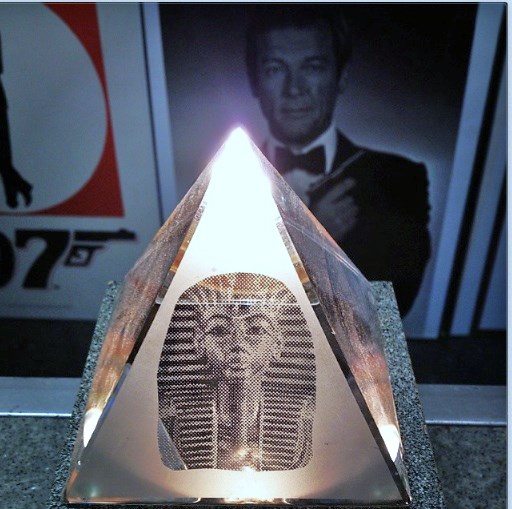
The Great Pyramid at Giza, Al Haram,
Nazlet El-Semman, Al Haram,
Giza Governorate, Egypten
SARDINIA "The Spy Who Loved Me" 1977
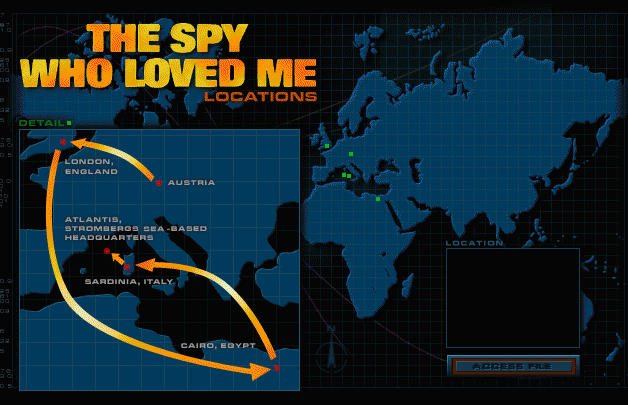
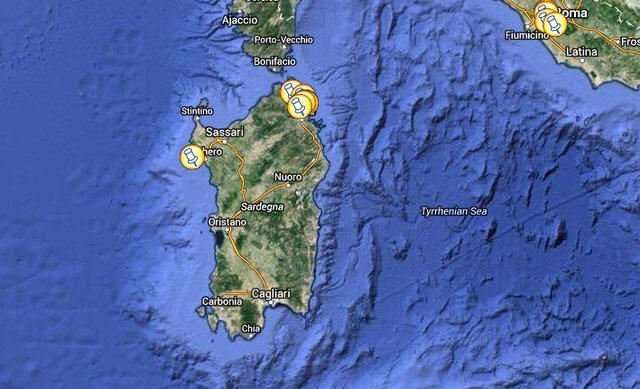
One of its more recent visitors was James Bond, who came here accompanied by
Soviet agent Triple-X Anya Amasova in The
Spy Who Loved Me (TSWLM) in 1977. In the plot of this film their
mission is to investigate the arch villain Karl Stromberg’s headquarters
Atlantis, a huge amphibian structure located off the coast of Sardinia. After
leaving Egypt and fighting Stromberg’s gigantic henchman Jaws in a fierce train
fight, the couple arrives at the little port-town of Palau at the northern tip
of Sardinia. From here regular ferry services operate to Genova and Naples on
the Italian mainland as well as to the nearby island of La Maddalena. A rock
shaped like a big bear (Capa d’Orso) is the only modest tourist attraction Palau
has to offer. Bond and Anya drive along the coastal road in an open carriage
backdropped by the beautiful Isola Santo Stefano. On reaching Palau’s jetty they
observe Q driving the white Lotus Esprit sports car from a ferry, which lies at
the outermost left moorings. He parks the car beside a sort of lamp-post and
then the usual banter between 007 and his gadget master ensues. Bond’s reckless
handling of the precious vehicle is obviously a “kick in the teeth“ for Q. All
of Bond’s following adventures take place at the Costa Smeralda, a region in the
northeast of Sardinia that defies easy description. A wonderful, untouched area,
without any roads, electricity, water or telephones: that was how Costa Smeralda
appeared at the beginning of the sixties.
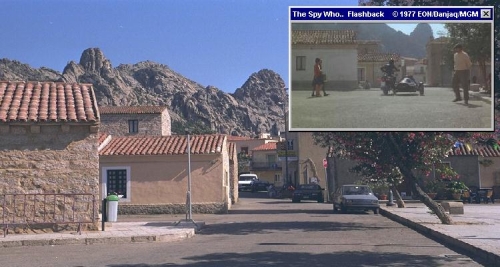
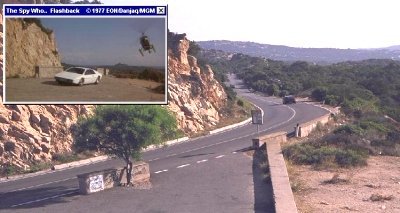
Most
parts of the following wild car chase were filmed on the country roads around
San Pantaleo, the National Road n. 125 and the Panoramica Cugnana SP 94 along
the Costa Smeralda. The most outstanding spot of the hot pursuit is the piece of
concrete wall, where the chopper pops up and which is circled twice by the Lotus
later in the race. To get to this location you have to drive south from Cala di
Volpe on the coastal road. After one odd mile you will notice a blue signpost
with the inscription “per bivio S. PANTALEO km 6“ on the left side of the road.
Directly behind that is the piece of wall which divides a little parking lot and
a view point from the pavement. From here you have a marvellous vista over the
shore. In the peak season try to be there before 10 am, because later it gets
very crowded.
SARDINIA – Hotel Cala di Volpe // The Spy Who Loved Me (1977)
Take a sip at your martini and watch the yachts come back from
their day cruise. Later on, pamper yourself at one of Sardinias finest
restaurants. Welcome: Your at a true Bond hotel!
Why Bond was here
James Bond (Roger Moore) and his Russian counterpart Triple X (Barbara Bach)
head from Egypt to Sardinia on
the trails of Karl Stromberg (Kurt Jürgens). The villain had stolen nuclear
submarines and is about to threaten the world with launching the nukes. The
agents try to get close to Stromberg, but in style – they check in at the luxury
hotel Cala di Volpe.
How you gonna get there
Cala di Volpe is one of the iconic landmarks at Costa Smeralda.
The philanthropist Aga Khan transformed the turquoise coastline into an oasis
for the rich back in the 1960s – and built up the
luxury hotel as
its main hub.
Cala di Volpe is close to Capricciola Bay. It is easily
signposted along the road from Olbia to Porto Cervo.
Good to know
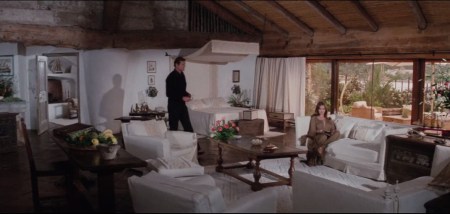
The suite Bond stays in is not a real suite – but
the Bar Pontile. The charming evening lounge was
turned into a hotel room in the movie. So filming took place in both the hotel
lobby and Bar Pontile.
It is located directly off the pier at the left side of the bay. The bar is
decorated with Mediterranean armchairs and carpets, a unique white fireplace
dominates the room. Opening hours are in the evening, but if you ask the staff,
they will probably unlook the Bond suite“ for you earlier.
First Bond movie filmed in Dolby Surround Stereo
First megalomaniac villain
First appearance of the Minister of Defense
First appearance of Robert Brown (plays Admiral
Hargreaves and would later play M)
First movie to be filmed on the 007 Soundstage at
Pinewood Studios. The soundstage was actually created for the movie,
as there were none in existence large enough to handle the action
scenes.
First appearance of Wet Nellie (as the
submarine-Lotus was named in honor of Little Nellie from You
Only Live Twice)
First time an Oscar-winning composer wrote the
music score in a Bond film (Marvin Hamlisch)
First film based on a Fleming book to have a new
novel written for the movie with the same title. The only thing that
the movie and Fleming's book have in common is the title.
First time that the theme song focuses on 007, not
the villain
The Spy Who Loved Me is the first movie in which
the leading lady has a rating as well as a name. Major Amasova is also
known as "Triple X".
First movie in which an automobile becomes a
submarine and is used in a battle
First appearance of the Shark Hunter mini-submarine
(reappears in
Licence To Kill
First time an American composer scored the film
(Marvin Hamlisch)
First time 007 skis off the edge of a cliff (stunt
was performed by Rick Sylvester)
First time the line "Shaken, but not
stirred" was used in an action sequence (Triple X says the line
after pinning Jaws behind a wall)
First time a music score from another film was used
in a Bond film (the score from Lawrence of Arabia)
First time 007 sees someone else behind M's desk
after speaking with Miss Moneypenny (General Gogol)
First time an oil tanker ship serves as the
villain's headquarters (the Liparus)
First appearance of a jet-ski/wave-runner (the
Wetbike)
First time 007 shoots a villain in his private
parts
First mention of Bond's late wife since she has
been dead (by Triple X showing off her knowledge of Bond when they
first meet)
First movie not coproduced by Harry Salzman
First time Bond appears in a tuxedo in the
gunbarrel sequence
First appearance of Victor Tourjansky
First time a Bond girl says, "oooh,
James"
Curt Jurgens as Carl Stromberg
Anatol Gogol
Naomi
(played by the sexy British actress Caroline Munro),
Naomi (played by the sexy British actress Caroline
Munro),
Film:
Spy who Loved Me, The (1977)
Deceased Character: Naomi (Caroline Munro)
Archetype: Baddy (Minor)
Killed by: James Bond (Roger Moore)
Killed with: Missile
Film: Spy who Loved Me, The (1977)
Deceased Character: Naomi (Caroline Munro)
Archetype: Baddy (Minor)
Killed by: James Bond (Roger Moore)
Killed with: Missile
The idea for Atlantis came from a Japanese floating
exhibit named Aquapolis used in Expo '75.
The submarine car was nicknamed Wet Nellie, an
obvious reference to Little Nellie.
Richard Kiel could only wear the metal teeth for a
few minutes at a time because they hurt so much.
This is Roger Moore's Favorite Bond film.
After the movie's release, requests for the white
Lotus Esprit surged to the point that some people had to be put on 3
year waiting lists.
The villain in The Spy Who Loved Me was
supposed to be Blofeld (along with SPECTRE), but legal wrangles with
Kevin McClory (who was about to embark on the alternate Bond project
Warhead, which later became
Never Say Never Again
1983
) forced Christopher Wood, the screenwriter, to remove any
reference to SPECTRE at the last moment. Stromberg's character was a
direct result of the screenplay changes.
The title is the only part of the original Ian
Fleming novel which was used in the film. When Ian Fleming sold the
film rights, he only sold the right to the title and not the actual
story. This is because the Fleming novel is principally about a female
character with Bond only appearing in the final quarter of the novel.
Fleming felt that as a result the story would not be appropriate for
the film series.
Roger Moore was injured shooting the scene where
Stromberg meets his end. If you look closely at the film, you'll see
Roger Moore's backside/back catch light from where the explosives on
his chair exploded prematurely.
There was a line that 007 should have said
after shooting Stromberg in his private parts. The line was "Ballseye,
Fishfinger", but was deemed too vulgar and obscene. If this line
made it into the final script, an R rating would have been the end
result.
To The 007 "Museum" from Caroline Munro Naomi love 007
The Spy Who Loved Me Ian Fleming's The Spy Who Loved Me
James Bond, Movie 1977
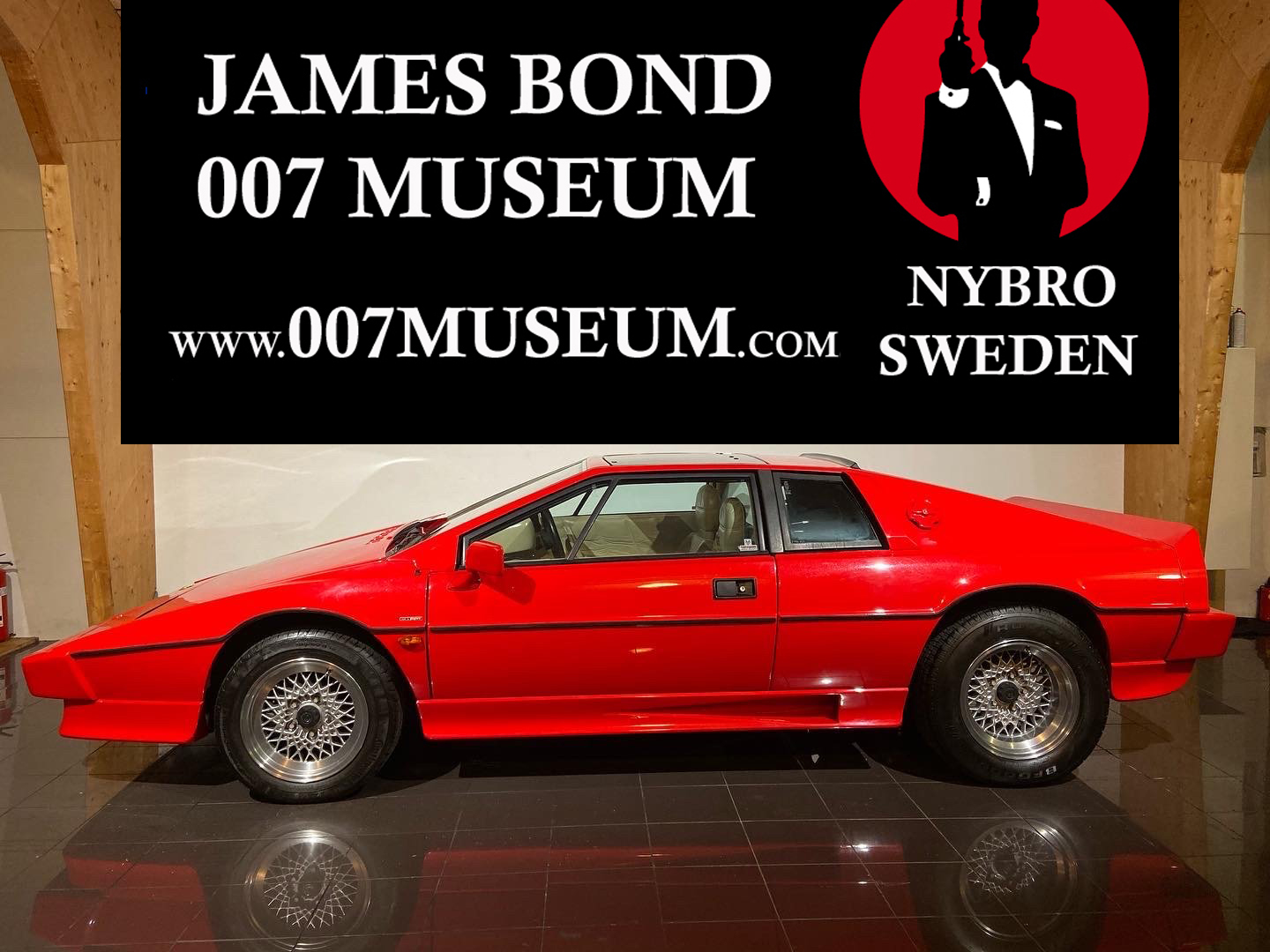
Lotus Esprit Turbo 1984 S3 214 hkRighthand
drive.
This is a Colin
Chapman
Giugiaro designed - collectors
item – used
in Bond movies.
Thedesign
is a little bit more edgy than
it usedto
be
–during
that time. Exterior
in Calypso Red and interior in Champagne
only 6 made.
This is also an example where Colin Chapman (founder of Lotus) used the
knowledge from building and competing in – Formula One.
Every driver loves the car and its agility.
It was Chapman who developed the concept to build light-weight cars.
There is just a few of them left in a good condition – that´s why the price
goes up -
continuously - in the UK. (In the US – even more.)
Harry Metcalfe, sports cars specialist and collector says his Esprit (-85)
is one of his best cars (actually, number three). Harry`s GARAGE has a new
interesting Esprit-video:- details above.
1. The car is in a very good condition.
2. Matching numbers. Original spare parts.
3. We can make a presentation of the owners, the service book stamps,
receipts etc.
4. The car has been refurbished by professionals – specialized on Lotus cars
(Bennets AB).
We have only used original spare parts, bought from Paul Matty's Sports Cars
(Bromsgrove, Worcestershire, UK).
Big projects that has been done:
- New paint work (with the original color number, paint work preservation by
Mr. Cap)
- Advanced engine reparation (shifting liner, piston, decock set turbo hc,
timing belt etc.)
The engine runs perfectly well and has a nice sound.
- Gearbox overhaul (cleaning/checking, shifting syncro-rings)
- Drive line (new crown-wheel and pinion etc.)
- New steering rack set
- Repairing and refurbishing the interior (leather and textiles)
- The clutch (driven plate, release bearing, pressure plate) and things
belonging to the clutch (as slave cylinder) has been shifted.
5. - New solinoid and alternator
6. - Newly refurbished turbo (2018)
7. - New tyres
8. - Water-reservoir refurbished
9. - New blinkers/indikators
10. Last ordinary service (oil, filter etc.) was done in april 2016.
11. The car has passed the ”Swedish MOT” (Bilprovningen)
without any problems – at all. Next test time is in April 2021-07-31.
12. Milage since refurbishment: 3000 km (totally: 105 000
kilometers).
13. Certificate of Vehicle Provenance is included.
This car was the 135th out of 137 cars 1984. The car was the
last out of 36 cars in Calypso Red. The last car out of 6 cars in Calypso
Red and Champagne (half leather
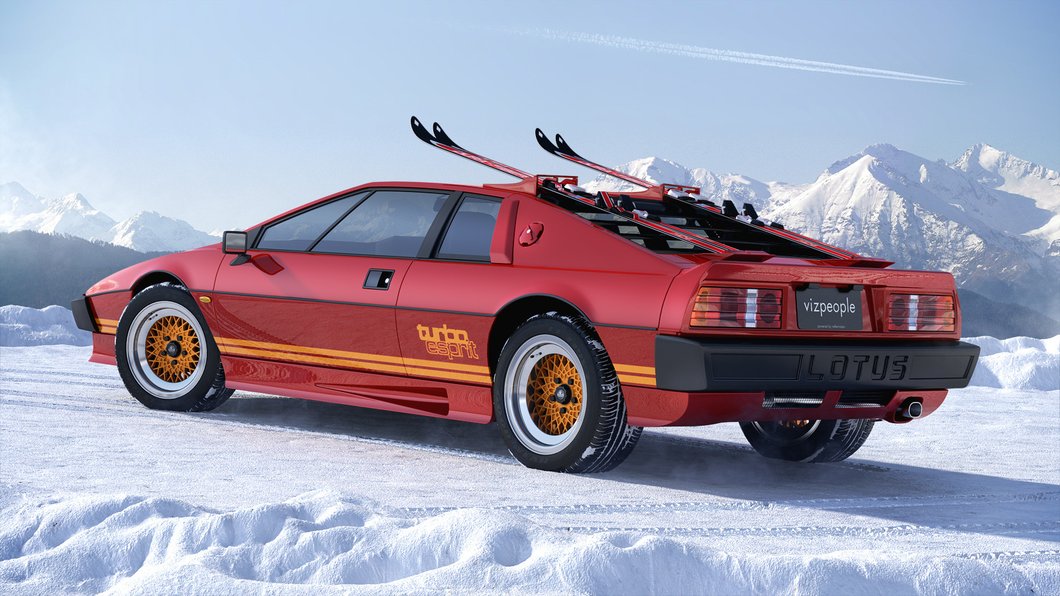
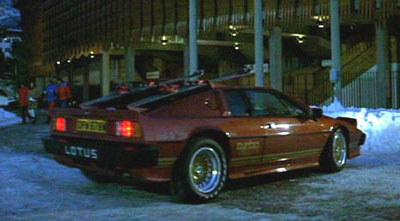
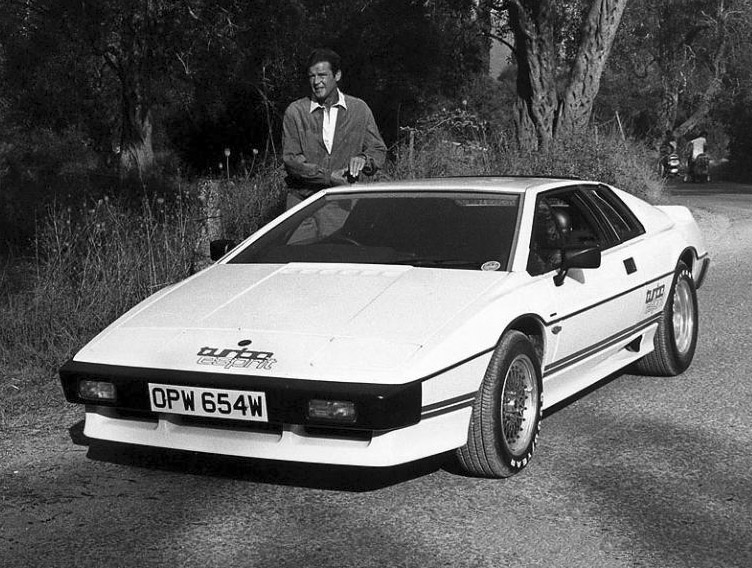
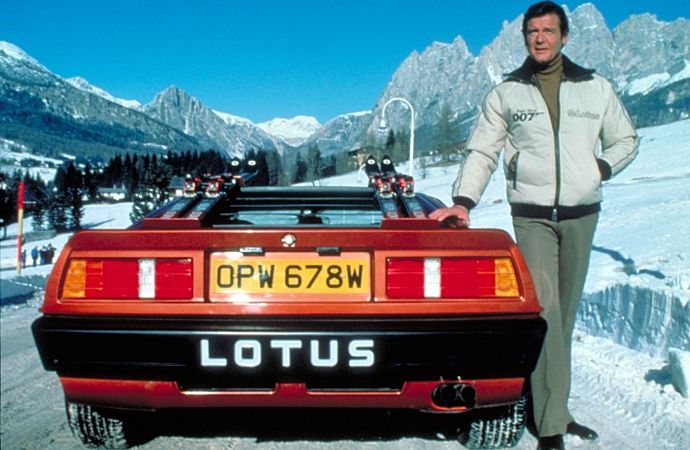
At the beginning of the film, a white Lotus Turbo Esprit was used, while Roger
Moore investigated Gonzale's House. 2 bad guys attempted to break into the car,
however, the security system activated and blew up the car! Not very clever
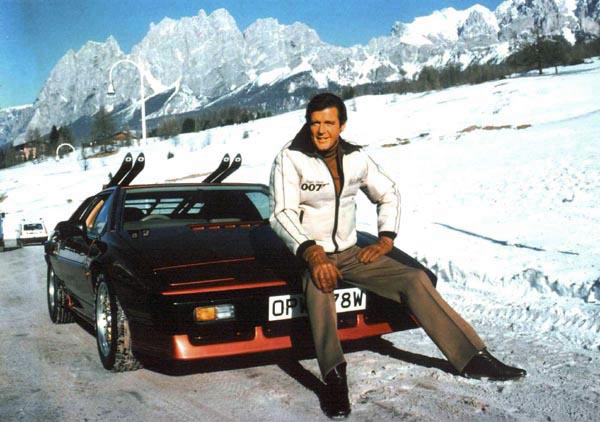
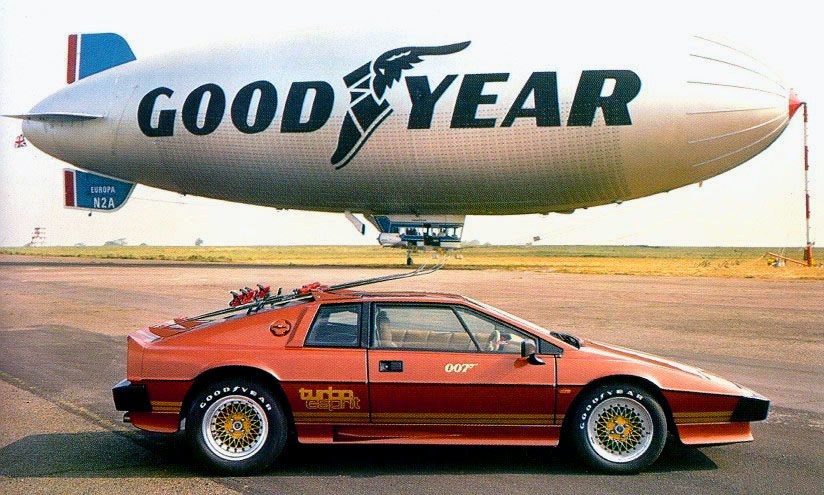
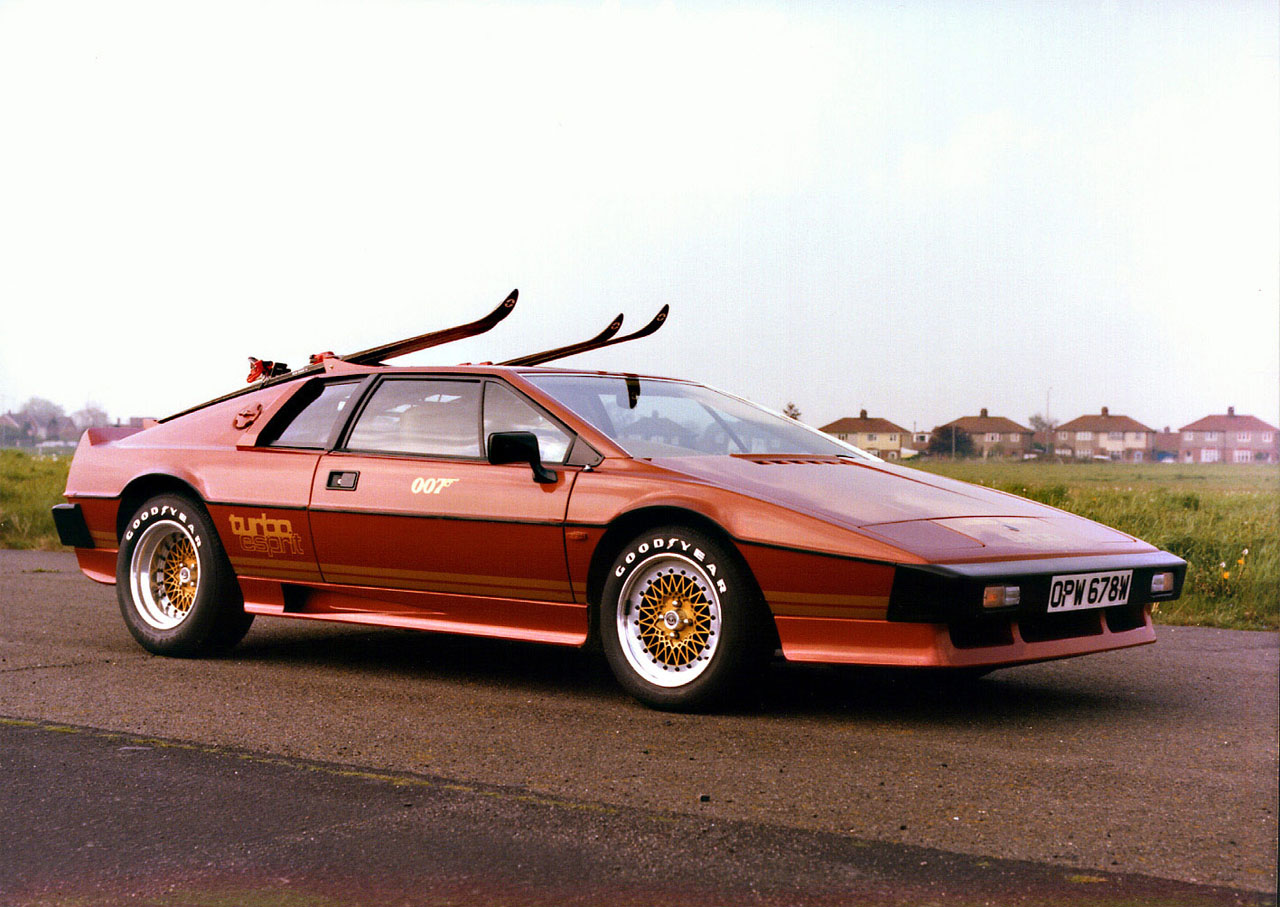
security device if you ask me. The second car was a copper coloured Turbo
Esprit, shown here, featuring a ski rack on the rear louvers. There were two
identical copper cars used in the filming. The second being purchased directly
from Lotus Cars in 1998. The car below was actually Lotus's 1980 Turbo Esprit
prototype and was originally white, but the car was painted copper, so it would
show up against the snowy backgrounds in the film. Both cars helped give the
Esprit Turbo some much need promotion and increased the profile of the car to
the general public.
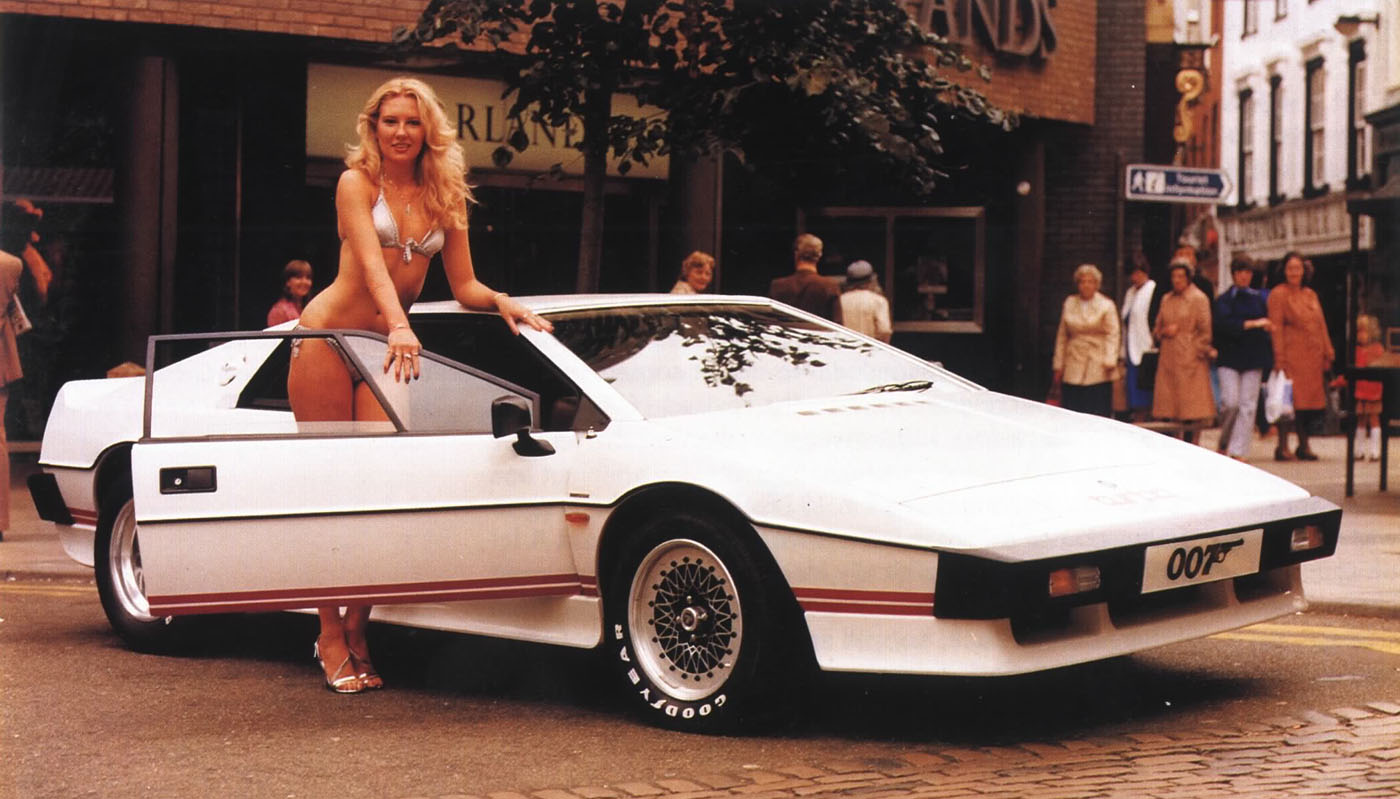
After the popularity of the white
Lotus Esprit S1, in the 1977 James Bond Film, The Spy Who Loved Me, the
new Turbo Esprit was featured in the 1981 film, For Your Eyes Only.
Where as the Esprit in the Spy Who Loved me was "an all sing, all dance"
submarine, the Turbo Esprit's took on less ambitious roles in the film.
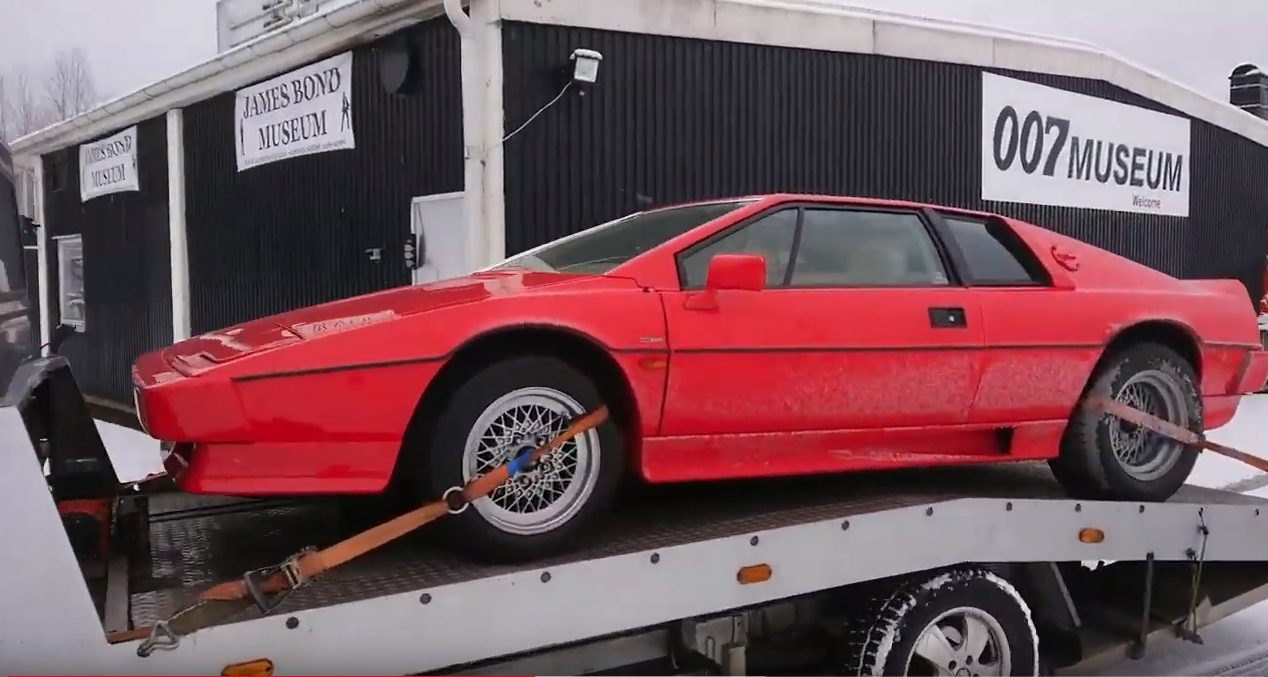
Fordonsinformation
Högerstyrd, Soltak i glas, Matching numbers, Certifikat ifrån
Lotus-fabriken finns, Kvitton och servicestämplar finns, Bilen har gått ca
400 mil sedan renovering, Totalrenoverad Turbo 2018, Nya däck runt om,
Nybesiktigad utan anmärkning, Mr Cap-behandlad, TIllverkad i England, Bilen
har genomgått ett flertal reparationer och förbättringar (gjorda utav
proffs), Endast 6 st bilar tillverkade i Calypso red med Champagne inredning
1984
At the beginning of
the film, a white Lotus Turbo Esprit was used, while Roger Moore
investigated Gonzale's House. 2 bad guys attempted to break into the car,
however, the security system activated and blew up the car! Not very
clever security device if you ask me. The second car was a copper
coloured Turbo Esprit, shown here, featuring a ski rack on the rear
louvers. There were two identical copper cars used in the filming. The
second being purchased directly from Lotus Cars in 1998. The car below
was actually Lotus's 1980 Turbo Esprit prototype and was originally
white, but the car was painted copper, so it would show up against the
snowy backgrounds in the film. Both cars helped give the Esprit Turbo
some much need promotion and increased the profile of the car to the
general public.
After the popularity of the white Lotus Esprit S1, in the 1977 James
Bond Film, The Spy Who Loved Me, the new Turbo Esprit S3 was featured in
the 1981 film, For Your Eyes Only. Where as the Esprit in the Spy Who
Loved me was "an all sing, all dance" submarine, the Turbo Esprit's took
on less ambitious roles in the film.
Two Essex-spec Turbo Esprits were featured in
the James Bond film For
Your Eyes Only. A white one destroyed early in the film
and a copper-red model appearing later.
An X180 Esprit appeared in the film Pretty
Woman after Ferrari and Porsche declined
the product placement opportunity because the manufacturers did
not want to be associated with soliciting prostitutes. Lotus saw
the placement value with such a major feature film and supplied
a Silver 1989.5 Esprit SE.
The Lotus Esprit sold for less than the guide
price despite a bidding war between a woman in the auction room and
a telephone bidder who took the prized collector's piece.
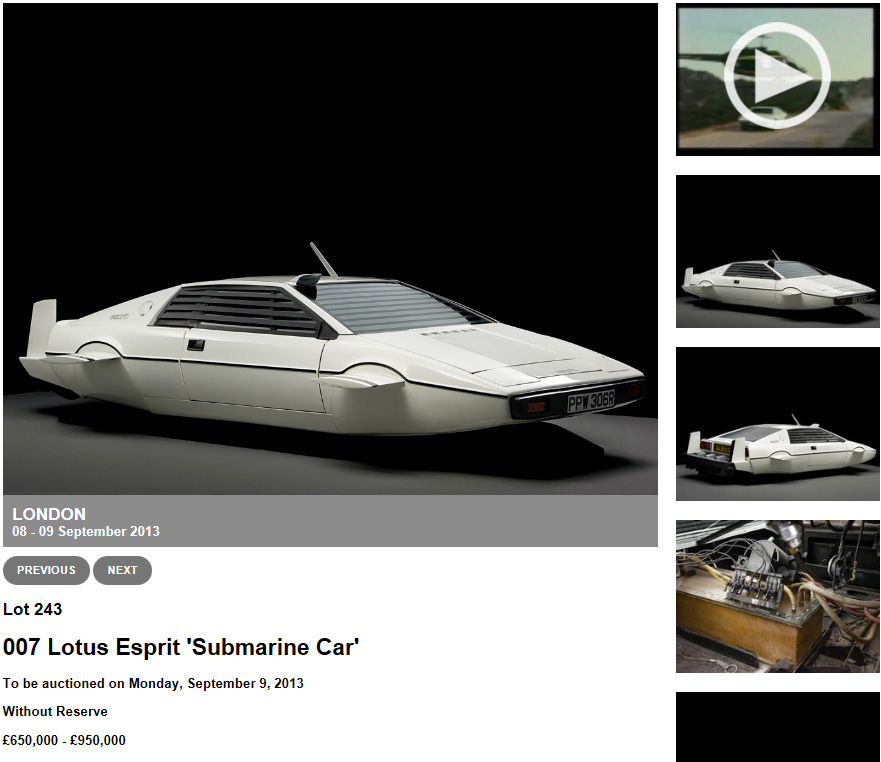
The car, said to be fully operational, was used in
the underwater scene of the 1977 film starring Roger Moore as 007.
After filming it toured various car shows before
being stored in New York.
It was sold at RM Auctions in Battersea,
south-west London, for less than the estimated price of between
£650,000 and £950,000.
In had previously been auctioned as a blind lot in
1989.
Peter Haynes, from the auction house, said:
"Bearing in mind it is not a car that can be driven on the road, the
price just goes to prove the draw that all Bond-related memorabilia
has."
1976 Lotus Esprit [Type 79] in The Spy
Who Loved Me, Movie, 1977
1976 Lotus Esprit [Type 79] in The Spy
Who Loved Me, Movie, 1977
1976
Lotus Esprit [Type 79] in The Spy Who Loved Me, Movie, 1977
1976
Lotus Esprit [Type 79] in The Spy Who Loved Me, Movie, 1977
1976
Lotus Esprit [Type 79] in The Spy Who Loved Me, Movie, 1977
Used in the James Bond film The Spy Who Loved
Me
The one and only fully functional Submarine
Car
One of the most famous movie cars of all time
Amazing story of lost and found
Never before offered for sale
WET NELLIE SURFACES
In conjunction with the 1977 release of The Spy Who Loved Me, U.S.
Lotus (Lotus East) executive distributor Fred Stevenson procured
Wet Nellie for display at auto shows, according to
correspondence between Stevenson and the location manager for
Eon in the Bahamas. Stevenson remembers the Lotus was full of
sand and seaweed upon delivery in New York and there was no time
to clean it prior to its first public debut at the New York Auto
Show! This was followed by appearances at shows in Cleveland,
Chicago, Denver, and Los Angeles, by which time its
custodianship was taken over by Lotus West. Stevenson relates
having great fun with the Lotus, discussing its unique features
with dignitaries and celebrities who enjoyed having their
photographs taken with Wet Nellie.
Eventually, Wet Nellie was shipped to Long Island, New York, where
it was kept in an unassuming storage unit in Holbrook, New York.
The lease was reportedly for a 10-year rental, paid in advance.
Fate later intervened when, in 1989, the rent delinquent unit
was put up “blind” at public auction. A modest winning bid from
an area couple brought surprise and wonder when the blankets
were removed to reveal the iconic 007 Submarine Car. The roof
had been damaged, but it was otherwise wholly intact. It’s new
(and current) owners recount that, whilst towing it home, the CB
radios of highway truckers were all abuzz about the sighting of
the famed Lotus. After positive authentication, Wet Nellie was
cosmetically restored and fitted to a custom-designed display
trailer and exhibited occasionally, including a stint at the
Petersen Automotive Museum in Los Angeles, but it was mostly
kept closely under wraps…until now.
NOBODY DOES IT BETTER
“Of all the Bonds I made”, remembers Roger Moore, “The Spy Who
Loved Me is the one I like best. The locations were right; the
costumes were right; everything on that movie went together”.
Sadly, Ian Fleming, the creator of the James Bond character and
originator of the first 007 gadget car on paper, is no longer
with us. However, Raymond Benson, author of seven “official”
posthumous Bond books, had this to say: “I never used an
underwater car in any of my Bond novels, but the Lotus in the
film is one of my favourite vehicles in the 007 universe!”
Today, Wet Nellie is presented with its restored, museum display
quality exterior, whilst inside, the full operational equipment
appears to be complete and original. This first-time-ever public
offering of the Lotus is accompanied by copies of numerous
period photos, rare movie stills, correspondence between Lotus
East and the film production team, auto show memorabilia, and
authentication documents.
The 007 Lotus Esprit Submarine Car is one of the most inspired
creations in the history of filmmaking. As such, we wouldn’t
want it to fall into enemy hands, so we invite those who can
enthusiastically appreciate its technology, ingenious
deployment, and legendary screen appearance to attentively
consider this once-in-a-lifetime opportunity to acquire Wet
Nellie, one of the most fascinating and entertaining movie
vehicles of all time.
BEHIND THE SCENES: EVOLUTION OF A GREAT SPY CAR
It is believed that Lotus provided two production “road cars”,
plus seven Esprit fibreglass body shells, to the filmmakers. One
of those shells was reported to have been split in half to film
Roger Moore and Barbara Bach in their separate seats. The
remaining six body shells, delivered bare, were used to initiate
and consummate filming the underwater scenes. Each of these
shells was modified to perform specific functions in the movie.
Here is the evolution of Wet Nellie on the screen:
1. Used for the tyre retraction sequence.
2. Used to portray the side fins protruding from the wheel arches
whilst the periscope extends.
3. Featured in the below-surface-to-air missile sequence from the
rear hatch.
4. Tethered to a powerful air cannon and jettisoned off the pier
and into the water below.
5. The spare unit for the above.
6. The one and only fully enclosed shell used to film the
functional Submarine Car.
Once filming was complete, the tyre shell (1) and the missile
shell (3) were left behind in the Bahamas and given as souvenirs
to Roberts Scrap Metal Company, who assisted with the heavy
equipment for the shoot. The tyre shell exists today in poor
condition in a Florida museum. The fin shell (2) has seemingly
disappeared (with its whereabouts unknown), whilst the missile
shell (3) is owned by the Ian Fleming Foundation and is proudly
on display as part of the on-going 50th Anniversary of James
Bond Exhibit at the Beaulieu National Motor Museum. The first of
the pier shells (4) was damaged by the air cannon during filming
in Sardinia, and it is presumed to have been discarded. The
other pier shell (5) may have been unused or used more lightly;
in any event, it was later unofficially retrofitted with mock up
gadgets and sold in the late 1980s.
Which leaves the one and only functional Submarine Car (6), which
is being offered to the public for the first time ever.
-Doug Redenius
Co-Founder, The Ian Fleming Foundation









 Most
parts of the following wild car chase were filmed on the country roads around
San Pantaleo, the National Road n. 125 and the Panoramica Cugnana SP 94 along
the Costa Smeralda. The most outstanding spot of the hot pursuit is the piece of
concrete wall, where the chopper pops up and which is circled twice by the Lotus
later in the race. To get to this location you have to drive south from Cala di
Volpe on the coastal road. After one odd mile you will notice a blue signpost
with the inscription “per bivio S. PANTALEO km 6“ on the left side of the road.
Directly behind that is the piece of wall which divides a little parking lot and
a view point from the pavement. From here you have a marvellous vista over the
shore. In the peak season try to be there before 10 am, because later it gets
very crowded.
Most
parts of the following wild car chase were filmed on the country roads around
San Pantaleo, the National Road n. 125 and the Panoramica Cugnana SP 94 along
the Costa Smeralda. The most outstanding spot of the hot pursuit is the piece of
concrete wall, where the chopper pops up and which is circled twice by the Lotus
later in the race. To get to this location you have to drive south from Cala di
Volpe on the coastal road. After one odd mile you will notice a blue signpost
with the inscription “per bivio S. PANTALEO km 6“ on the left side of the road.
Directly behind that is the piece of wall which divides a little parking lot and
a view point from the pavement. From here you have a marvellous vista over the
shore. In the peak season try to be there before 10 am, because later it gets
very crowded.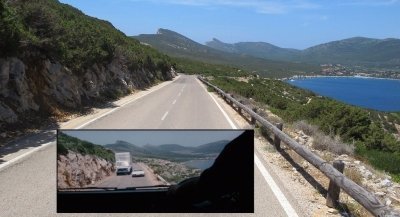


![1976 Lotus Esprit [Type 79] in The Spy Who Loved Me, Movie, 1977](lotus_esprite.jpg)
![1976 Lotus Esprit [Type 79] in The Spy Who Loved Me, Movie, 1977](lotus_esprite1.jpg)
![1976 Lotus Esprit [Type 79] in The Spy Who Loved Me, Movie, 1977](lotus_esprite2.jpg)
![1976 Lotus Esprit [Type 79] in The Spy Who Loved Me, Movie, 1977](lotus_esprite3.jpg)
![1976 Lotus Esprit [Type 79] in The Spy Who Loved Me, Movie, 1977](lotus_esprite4.jpg)
![1976 Lotus Esprit [Type 79] in The Spy Who Loved Me, Movie, 1977](lotus_esprite5.jpg)
_left-front_National_Motor_Museum,_Beaulieu.jpg)