Contact:
007museum@telia.com
 Phone+4648112960
Open Daily 10-17 Sat 10-14 Media
To do and see
Buy/Köp info
Links
Phone+4648112960
Open Daily 10-17 Sat 10-14 Media
To do and see
Buy/Köp info
Links
James Bond Theme Party
PPKGuns Omega
Bmw
Bollinger Corgi,
Cd,
Swatch
Posters,
Specials James Bond store
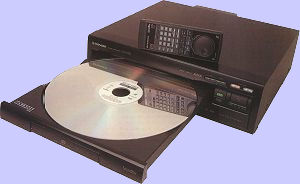
Laserdisc (LD) was the first commercial optical
disc storage medium, and was used primarily for movies
for home viewing.
 |
Laserdisc är föregångaren till
DVD-skivan. Finns i flera olika storlekar. Vanligast är 12", som
alltså är lika stora som LP-skivor.
Inte helt ovanlig är heller 8"-skivor som bl a använts mycket för
musikvideo. Både bild och ljud lagras analogt, även om det är optiska
skivor. Genom olika moduleringsteknik kan man dock få en digitalsignal
lagrad på den analoga bärvågen. |
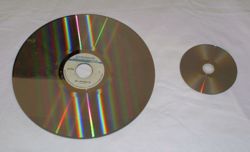
Laserdisc (left) compared to a DVD/CD
(right). |
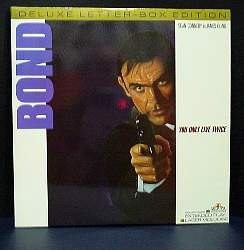 |
You Only Live Twice
LaserDisc Widescreen version with trailer.
Pris: 998:- Us : $139
Nr : 007- 50600
|
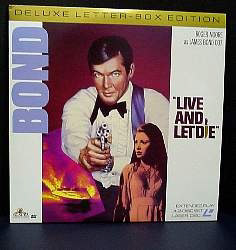 |
Live and Let Die
LaserDisc. Widescreen version with trailer.
Pris: 998:-
Us : $139
Nr : 007- 50610 |
|
Laserdisc Title:
James Bond "You Only Live Twice"
|
| Edition:
Deluxe Letter-Box Edition, Extended Play |
| Directed by:
Lewis Gilbert |
| Starring: Sean
Connery Akiko Wakabayashi, Lois Maxwell, Desmond Llewelyn |
| Publisher / Year: MGM/UA
Home Video 1967 |
| Running Time: 116
Minutes / Color |
| Rating:
PG |
| Catalog Number:
ML101565 |
|
Synopsis:
Sean Connery, the original 007, catapults you into James Bond's
world of high-tech combat, exotic women and outrageous, deadly -
yet always impeccably well-mannered - arch villains. You
Only Live Twice is the last consecutive Bond film to star
Sean Connery.
Time is running out. From their secret base on a Japanese
island, Blofeld (Donald Pleasence) and the fanatics at SPECTRE
hijack both an American and a Soviet spaceship. Accusations fly,
and a superpower war is imminent. 007must infiltrate SPECTRE's
heavily fortified hideout. But the countdown to destruction has
already begun!
Spectacular sets (SPECTRE's volcano fortress cost
$1,000,000), chases and special effects - with just the right
dose of devilishly dry Bond wit - combine to deliver the
razor-edged thrills and excitement that have made James Bond the
world's most popular and enduring screen spy.
|
|
LASERDISC
INFORMATION
| Catalog Number: |
ML101418 |
| Genre: |
Action |
| Published by: |
MGM/UA Home Video |
| Directed by: |
Guy Hamilton |
| LD Released: |
15/01/1991 |
| Origin: |
USA |
| Color: |
Color |
| Playing Time: |
124 min. |
| Sides: |
3 |
| Aspect Ratio: |
1.85:1 Wide Screen |
| Cover Style: |
Gatefold |
| Encoding: |
CLV/CAV |
|
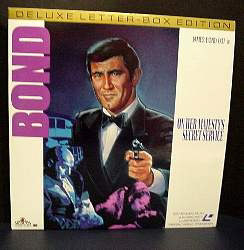 |
On
Her Majesty Secrte Service
LaserDisc Widescreen version with trailer.
Complete version 135 minutes.
Pris:
998:- Us : $139
Nr : 007-50620
|
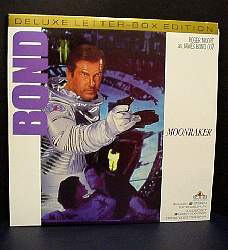 |
Moonraker
LaserDisc.
Widescreen version with trailer.
Pris: 998:-
Us : $139
Nr : 007-50630 |
|
On Her Majesty's Secret
Service '69 LASERDISC LB-NIP
Rare & HTF George Lazenby Bond Title
Catalog #: ML101788.
George Lazenby, Diana Rigg and Telly Savalas.
1969/Widescreen/135 Minute Runtime/New-In-Package (NIP)/DVT/GF/2
Disc.
Also includes the Theatrical Trailer.
|
Moonraker '79 LASERDISC LB
DVT-Roger Moore/Lois Chiles
Catalog #: ML101710.
Roger Moore, Lois Chiles and Michael Lonsdale.
1969/Widescreen/126 Minute Runtime/DVT/GF/2 Disc.
- 2 DISC, 3 SIDES
- NTSC CLV, SIDE 3 CAV
- APPROX: 126 MIN
- STEREO, DIGITAL SOUND & DOLBY SURROUND
- WIDESCREEN
- INCLUDES THE ORIGINAL THEATRICAL RELEASE TRAILER
- MINT CONDITION
|
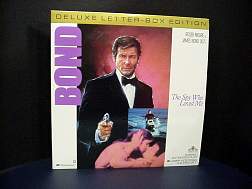 |
The
Spy Who Loved Me
LaserDisc. Widescreen version med trailer.
Pris: 998:-
Us : $139
Nr : 007-50680
|
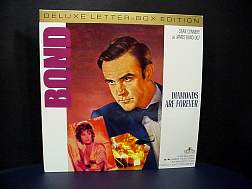 |
Diamonds
Are Forever
LaserDisc. Widescreen version med trailer.
Pris: 998:- Us
: $139
Nr : 007-
50690 |
|
Laserdisc Title:
James Bond "The Spy Who Loved Me"
|
| Edition:
Deluxe Letter-Box Edition, 2-Disc Set Extended Play |
| Directed by:
Lewis Gilbert |
| Starring: Roger
Moore, Barbara Bach, Curt Jurgens, Richard Kiel, Caroline Munro |
| Publisher / Year: MGM/UA
Home Video 1977 |
| Running Time: 129
Minutes / Color |
| Rating:
PG |
| Catalog Number:
ML101743 |
|
Synopsis:
From the death-defying opening that finds Agent 007 nonchalantly
skiing straight off a 3,000-foor mountain precipice to the
explosive finale aboard a humongous supertanker, The Spy Who
Loved Me is Bond at his exhilarating best!
With dashing good looks and irrepressible charm, Roger Moore
as 007 finds himself partnered with voluptuous Soviet agent XXX
(Barbara Bach). Together they battle to save the world from
total annihilation - this time at the hands of a menacing
megalomaniac named Stromberg (Curt Jurgens.).
The extravagant production offers exotic Egyptian and
Sardinian locales, a gallery of inventive gadgets topped by an
amphibious Lotus Esprit. And the largest interior set ever built
comfortably houses three nuclear submarines!
But undoubtedly the most outrageous spectacle of all is the
7'2", 315-pound villain known as "Jaws" (Richard
Kiel), whose sadistic specialty is tearing out people's throats
with his stainless steel teeth. It's Bond and beyond...and
nobody does it better.
|
|
|
Laserdisc Title:
James Bond "Diamonds Are Forever"
|
| Edition:
Deluxe Letter-Box Edition, 2-Disc Set, Extended Play |
| Directed by:
Guy Hamilton |
| Starring: Sean
Connery, Jill St. John, Charles Gray, Lana Wood, Jimmy Dean |
| Publisher / Year: MGM/UA
Home Video 1971 |
| Running Time: 125
Minutes / Color |
| Rating:
PG |
| Catalog Number:
ML101741 |
|
Synopsis:
A fortune in diamonds brings Sean Connery back to the screen for
his sixth James Bond adventure. Director Guy Hamilton makes
Connery's return (after four years) memorable with fantastic
sets, gorgeous co-stars, and one of the most exciting car chase
scenes ever filmed!
Smugglers are out to capture the world's glittering diamond
market. Bond uses fast cars, hearses, jets, helicopters, and
moon machines in a perplexing search to find out why. Seductive
smuggler Tiffany Case (Jill St. John) does her best to keep 007
"on top of things" afloat a bridal-suite water bed
filled with tropical fish. From his luxurious Las Vegas hotel
penthouse, millionaire recluse Willard Whyte (Jimmy Dean) add a
new piece to the puzzle when he reveals his sinister identity
and evil purpose.
Academy Award-winning cinematographer Ted Moore expertly
films the movie's explosive and fiery climax.
|
|
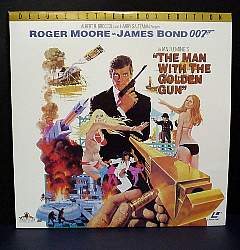 |
The
Man With The Golden Gun
LaserDisc. Widescreen version with trailer.
Pris: 998:-
Us : $139
|
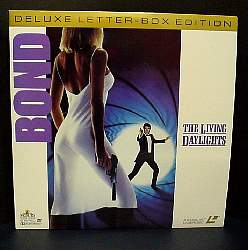 |
The
Living Daylights
LaserDisc. Widescreen version with trailer.
Pris: 998:-
Us : $139
Nr : 007- 50650 |
- 2 DISC, 3 SIDES
- NTSC CLV
- APPROX: 125 MIN
- DIGITAL SOUND
- INCLUDES THE ORIGINAL THEATRICAL RELEASE TRAILER
- NEAR MINT CONDITION
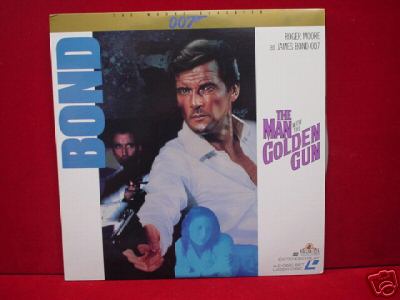
Nr : 007- 50640
|
|
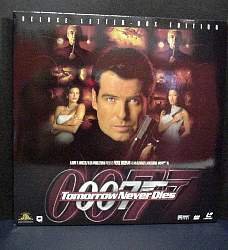
Tomorrow Never Dies
1997 / 119 minutes / Colour
Rated PG-13
Movie Review for LaserDisc LD:
In TOMORROW NEVER DIES, British super-spy James Bond (Pierce Brosnan) goes after a ruthless media baron, Elliot Carver--an amalgam of Ted Turner, Rupert Murdoch, and Bill Gates--played with feisty aplomb by Jonathan Pryce. Carver's diabolical plan is to instigate World War III so that his empire can obtain exclusive coverage (a la CNN during the Gulf War). This time, 007 must endure the sorrow of love lost as he shares a nostalgic interlude with his ex-lover Paris (Teri Hatcher) who is now married to his nemesis, Carver. He also discovers a worthwhile partner in a female Chinese counterpart, Wai Lin (Hong Kong action diva Michelle Yeoh). Noteworthy for its unabashed commercial product placement, TOMORROW NEVER DIES follows the sharp direction of Roger Spottiswoode.
Cast:
Pierce Brosnan
Jonathan Pryce
Michelle Yeoh
Teri Hatcher
Ricky Jay
Gotz Otto
Joe Don Baker
Vincent Schiavelli
Judi Dench
Desmond Llewelyn
Samantha Bond
Colin Salmon
Geoffrey Palmer
Julian Fellowes
Terence Rigby
Cecilie Thomsen
Nina Young
Daphne Deckers
Colin Stinton
Al Matthews
Mark Spalding
Bruce Alexander
Anthony Green
Christopher Bowen
Andrew Hawkins
Dominic Shaun
Julian Rhind-Tutt
Gerard Butler
Adam Barker
Michael Byrne
Pip Torrens
Hugh Bonneville
Jason Watkins
Eoin McCarthy
Brendan Coyle
David Ashton
William Scott-Masson
Laura Brattan
Nadia Cameron
Liza Ross
Hugo Napier
Rolf Saxon
Vincent Wong
Philip Kwok
Crew:
Roger Spottiswoode Director
Bruce Feirstein Screenwriter
Robert Elswit Director of Photography
Barbara Broccoli Producer
Michael G. Wilson Producer
Michel Arcand Editor
Dominique Fortin Editor
Allan Cameron Production Designer
Lindy Hemming Costume Designer
Sheryl Crow Music Performer
Frank Denson Composer
David Arnold Composer
|
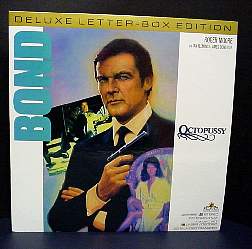
Octopussy
1983 - UK - 131 min. - Feature, Colour
Director John Glen
Genre/Type Action, Spy Film, Action Thriller, Glamorized Spy Film
Box office Domestic gross: $64,300,000
From story Octopussy, The Property of a Lady
Colour type MetroColour
Cinematic Process Panavision
Sound by Dolby
Produced by Eon Productions / MGM / MGM/United Artists / United Artists
Release Jul 10, 1983 (USA)
Movie Review for LaserDisc LD:
This (13th) time around, "007" receives the usual call to come and visit "Mother" when another agent drops off a fake Faberge jeweled egg at the British embassy in East Berlin and is later killed at a traveling circus. Suspicions mount when the assistant manager of the circus Kamal (Louis Jourdan), outbids Bond for the real Faberge piece at Sotheby's. Bond follows Kamal to India where the superspy thwarts many an ingenious attack and encounters the antiheroine of the title (Maud Adams), an international smuggler who runs the circus as a cover for her illegal operations. It does not take long to figure out that Orlov (Steven Berkoff), a decidedly rank Russian general is planning to raise enough money with the fake Faberges to detonate a nuclear bomb in Europe and then defeat NATO forces once and for all in conventional warfare. As always, it is up to Bond to save the day, win the woman, and perform unimaginable feats of derring-do in the process. --- Eleanor Mannikka
Octopussy is one of the cleaner and more entertaining of Roger Moore's Bond films, despite a title that tends to elicit blushes. Bond films are always a miniature world tour, but this one's plot carries off the usual jet-setting with more finesse than some of its predecessors and some that followed. It's got a Colourful slate of villains, starting with Louis Jourdan's slippery Kamal Kahn and Robert Orlov's vain-popping Russian general, and continuing with such minions as the bodyguard who can crush dice in his fist, the twin circus knife throwers, and the man with the yo-yo razor blade. Memorable set pieces include a dangerous ride through an Indian marketplace and the safari game hunt in which Bond is the target. But the film's lingering image is of Bond sliding down an ornate banister, machine gun blazing, just barely blowing off the decorative flourish at the bottom to keep his privates from getting pulverized. Ever perfecting that playful grin and dry wit, Moore makes his sixth and penultimate Bond film, one of the series' more satisfying. Octopussy was one of eight Bond films that John Glen either directed or edited. --- Derek Armstrong
Starring:
Roger Moore - James Bond
Maud Adams - Octopussy
Louis Jourdan - Kamal
Kristina Wayborn - Magda
Kabir Bedi - Gobinda
Steven Berkoff - Orlov
David Meyer - twin
Vijay Amritraj - Vijay
Desmond Llewelyn - "Q"
Robert Brown - "M"
Walter Gotell - Gogol
Geoffrey Keen - Minister of Defense
Suzanne Jerome - Gwendoline
Cherry Gillespie - Midge
Albert Moses - Sadruddin
Douglas Wilmer - Fanning
Andrew Bradford - 009
Lois Maxwell - Miss Moneypenny
Michaela Clavell - Penelope Smallbone
Peter Porteous - Lenkin
Eva Reuber-Staier - Rublevitch
Carole Ashby - Octopussy Girl
Richard Parmentier - U.S Aide
Ken Norris - Col. Toro
Patrick Barr - British Ambassador
Philip Voss - Auctioneer
Gabor Vernon - Borchoi
Cheryl Anne - Octopussy Girl
Tina Robinson - Octopussy Girl
Stuart Saunders - Maj. Clive
Mary Stavin - Octopussy Girl
Gurdial Sira - Thug
Brenda Cowling - Schatzl
David Grahame - Petrol Pump Attendant
Richard Graydon - Francisco the Fearless
Michael Halphie - South American Officer
Dermot Crowley - Kamp
Brian Coburn - South American VIP
William Derrick - Thug with Yo-yo
Bruce Boa - U.S. General
Julie Martin
Hugo Bower - Karl
Anthony Meyer - Twin Two
Paul Hardwick - Soviet Chairman
Ray Charles - Thug
Gertan Klauber - Bubi
Jeremy Bulloch - Smithers
Crew:
John Glen - Director
Albert R. Broccoli - Producer
Michael G. Wilson - Producer / Screen Story / Screenwriter / Executive Producer
George MacDonald Fraser - Screenwriter / Screen Story
Richard Maibaum - Screenwriter / Screen Story
Alan Hume - Cinematographer
John Barry - Songwriter / Composer (Music Score)
Tim Rice - Songwriter
Peter Davies - Editor
John Grover - Editor
Henry Richardson - Editor
Peter Lamont - Production Designer
John Fenner - Art Director
Tom Pevsner - Associate Producer
Derek Ball - Musical Direction/Supervision / Sound/Sound Designer
Jack Stephens - Set Designer
Emma Porteous - Costume Designer
Eric Allwright - Makeup
George Frost - Makeup
Peter Robb-King - Makeup
Anthony Waye - First Assistant Director
Rita Coolidge - Singer
Del Baker - Stunts
Pat Banta - Stunts
Billy Burton - Stunts
Clive Curtis - Stunts
Jim Dowdall - Stunts
Dorothy Ford - Stunts
Martin Grace - Stunts
Nick Hobbs - Stunts
Jazzer Jeyes - Stunts
Remy Julienne - Stunts
Wayne Michaels - Stunts
Malcolm Weaver - Stunts
Christopher Webb - Stunts
Paul Weston - Stunts
John Richardson - Special Effects Supervisor
Arthur Wooster - Second Unit Director
|
Tomorrow
Never Dies
LaserDisc. Widescreen version with trailer.
Pris: 998:-
Us : $139
Nr : 007- 50660
|
Rare Factory-Sealed, Dolby Surround Sound, Widescreen, LaserDisc
Movie
Near-Mint Condition with one compressed corner
Roger Moore & Maud Adams in...
Octopussy
( Catalogue Number ML101640 ) (2.10:1) (DSS) (3 Sides)
(CLV+CAV) (NTSC)
Featuring...
- The Best Version on LaserDisc
- Original Theatrical Trailer
- See Many More James Bond and Spy Movies at DaDon's...
Octopussy
LaserDisc.
Widescreen version with trailer.
Pris: 998:-
Us : $139
Nr : 007- 50670
|
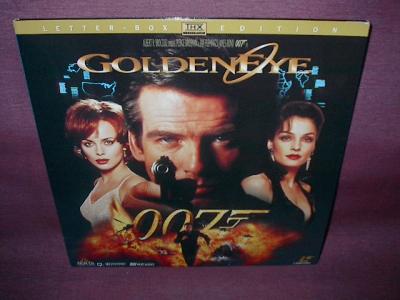
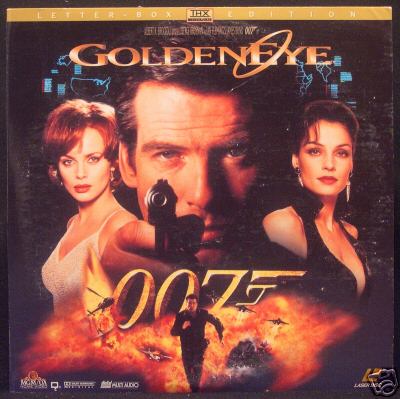
James Bond GoldenEye Letter-Box Edition LaserDisc
- 1 DISC, 2 SIDES
- NTSC CLV
- APPROX: 119 MIN
- MINT CONDITION
GoldenEye
( Catalog Number ML105544 ) (1995) (2.40:1) (AC-3) (THX) (4 Sides)
(CLV+CAV) (NTSC)
Special Features:
- Audio Commentary by Martin Campbell and Michael G. Wilson
- Exclusive 44 minute Documentary called "The World of
007", hosted by Elizabeth Hurley
- 15 Original Theatrical Trailers
- Side 4 in CAV contains "The Goldeneye Dossier" which
consists of the following: The Teaser Trailer, a five minute
Production Featurette, the Original Release Trailer, 13 TV Spots,
the GoldenEye Music Video with Tina Turner and "James Bond
International" (which is the scene where Bond is called into
new M's office, presented in three foreign languages, Italian,
French and German)
- The Best Version on LaserDisc
|
JAMES BOND - GOLDENEYE - WS - THX -
AC-3 - LD
- GoldenEye
1995 - USA - 130 min. - Feature, Color
Director Martin Campbell
Genre/Type Spy Film, Action, Glamorized Spy Film, Action Thriller
MPAA Rating PG13
Box office $46.099 million / Among top grossing films of 1995
Set In Russia, St. Petersburg, Russia
Key name James Bond
Produced by MGM/United Artists
Release Nov 19, 1995 (USA)
Description:
Pierce Brosnan made his first appearance as James Bond in this action thriller, the 17th in the series featuring the suave British super-agent. As the story begins, Agent 007 and his partner Agent 006 (Sean Bean) pull a daring raid on a chemical weapons plant in the Soviet Union. However, they are captured by Russian troops, and while Bond is able to escape, 006 is not so lucky. Several years later, the Soviet Union and the Cold War are a thing of the past, but Bond is still at work ferreting out evildoers everywhere. Xenia Onatopp (Famke Janssen), a beautiful but vicious villain working with the Russian Mafia, spearheads the theft of the controls to GoldenEye, a high-tech satellite weapons system, and with her gunmen, she kills most of the soldiers and guards at a top-secret military facility in the process. Bond joins forces with Natalya Simonova (Izabella Scorupco), one of the base's few survivors, to help track down Onatopp's minions and the controls to GoldenEye, which can destroy all electronic circuits in a given area in a matter of seconds. However, in time, Bond discovers the true identity of the criminal mastermind who is behind this bid for unholy power and world domination ---- none other than Alec Trevelyan, the man Bond once knew as 006. In addition to Brosnan, GoldenEye also marked another significant cast change for the Bond series ---- Judi Dench made her debut as M, Bond's superior. Minnie Driver also has a cameo as a nightclub singer. Sadly, this was the last film in the Bond series for special effects supervisor Derek Meddings, who died in the midst of production; the film was dedicated to him. --- Mark Deming
The debut of Pierce Brosnan in the role of Agent 007 and of director Martin Campbell behind the camera provide a much-needed injection of freshness into the stale James Bond franchise with this, the 18th in the series of spy thrillers. Since Bond tales are best reviewed not in relation to other films but in relation to themselves, here's what works: Brosnan infuses his Bond with the best of both worlds, mixing the suave, winking charm of Roger Moore with the more arch, lethal detachment of Sean Connery. Campbell, for his part, brings pace and visual flair to the proceedings, never losing sight of the class fans have come to expect, while eschewing many of the ludicrous stunts and gizmos for more believable real-world action. A team of screenwriters also wisely updates Bond for the politically correct '90s by transforming the character of M into a woman (portrayed with delightful sobriety by the great Judi Dench). And supporting players Alan Cumming and Famke Janssen are standouts in a series that prides itself on memorable villains. What doesn't work: Sean Bean as an antagonist who comes across as too dim to carry out his complex scheme, Izabella Scorupco, lifeless and boring in place of the expected exciting and sexy, and the basic plot, which bows to the graying maxims that Bond must never grow or develop and that Russians make the best villains. GoldenEye is a mixed bag, but a promising start for a star and director who could do better with improved material. --- Karl Williams
Cast:
Pierce Brosnan - James Bond
Sean Bean - Alec Trevelyan
Izabella Scorupco - Natalya Simonova
Famke Janssen - Xenia Onatopp
Joe Don Baker - Jack Wade
Judi Dench - M
Gottfried John - Gen. Ourumov
Tchky Karyo - Dimitri Mishkin
Billy Mitchell - Admiral Chuck Farrel
Peter Majer - Valentin's Bodyguard
Michael Kitchen - Bill Tanner
Desmond Llewelyn - Q
Samantha Bond - Moneypenny
Robbie Coltrane - Valentin Zukovsky
Alan Cumming - Boris Grishenko
Trevor Byfield - Train Driver
Ravil Issyanov - MIG Pilot
Constantine Gregory - Computer Store Manager
Minnie Driver - Irina
Serena Gordon - Caroline
Starring:
Martin Campbell - Director
Barbara Broccoli - Producer
Michael G. Wilson - Producer
Jeffrey Caine - Screenwriter
Bruce Feirstein - Screenwriter
Michael France - Story Author
Kevin Wade - Screenwriter
Harvey Harrison - Cinematographer
Phil Meheux - Cinematographer
Arthur Wooster - Cinematographer / First Assistant Director
John Altman - Musical Direction/Supervision
Bono - Songwriter
The Edge - Songwriter
Nellee Hooper - Musical Direction/Supervision
Eric Serra - Composer (Music Score)
Terry Rawlings - Editor
Peter Lamont - Production Designer
Andrew Ackland-Snow - Art Director
Kathrin Brunner - Art Director
Neil Lamont - Art Director
Chares Lee - Art Director
Anthony Waye - Associate Producer
Tom Pevsner - Executive Producer
Michael Ford - Set Designer
Lindy Hemming - Costume Designer
David John - Sound/Sound Designer
Linda de Vetta - Makeup
Chris Corbould - Special Effects
Gerry Gavigan - First Assistant Director
Ian Sharp - First Assistant Director
Tina Turner - Singer
Simon Crane - Stunts
Debbie McWilliams - Casting
|
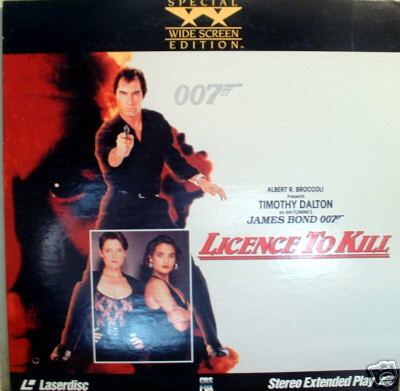
Licence To Kill WS LD 007 James Bond
Dalton
Rare Remastered, Dolby Surround Sound, Widescreen, LaserDisc Edition
Timothy Dalton & Carey Lowell in...
Licence To Kill
( Catalog Number ML104553 ) (2.35:1) (1989) (DSS) (3 Sides) (CLV)
(NTSC)
Special Features:
Best Version on LaserDisc
Original Theatrical Trailer
Bond Movies on LaserDisc Listed in the Store
Please zoom-in on actual hi-res photo for details. Kept in a
controlled environment. This is a 12" LaserDisc not a DVD.
Visit Da Don's Store for over 850 of the Rarest LaserDiscs in the
World!
|
Licence To Kill
1989 / 133 Minutes / Color
Rated PG-13
Description:
James Bond (Timothy Dalton) returns with a vengeance in LICENCE TO KILL. Having just witnessed his best friend's wedding, Bond is shocked when he learns that ruthless drug runner Franz Sanchez (Robert Davi) has assaulted the couple on their honeymoon, killing the bride. Assisted by the twiggy Drug Enforcement Agent Pam Bouvier (Carey Lowell) and the gadget wizard Q (Patrick Llewelyn), Bond resigns from Her Majesty’s Secret Service and pursues justice on his own. Perhaps the darkest of the 007 films, LICENCE TO KILL, exhibits a previously unseen side of James Bond. Maniacal at times, ex-agent 007, detonates everything in his way on the road to avenging his friend's bride.
The 16th installment of the James Bond series, LICENCE TO KILL, veers away from the pick-up artistry and light interlocution of former 007 films. Instead, director John Glen, gives the audience a crystal clear view of the man behind the martini glass.
Cast:
Timothy Dalton
Carey Lowell
Robert Davi
Anthony Zerbe
Talisa Soto
Wayne Newton
Crew:
John Glen Director
Richard Maibaum Story
Michael G. Wilson Screenwriter
Albert R. Broccoli Executive Producer
Alec Mills Director of Photography
John Grover Editor
Jodie Tillen Costume Designer
Michael Kamen Composer |
Laserdisc (LD) was the first commercial optical
disc storage medium, and was used primarily for movies
for home viewing.
During its development, MCA,
which owned the technology, referred to it as the Reflective Optical
Videodisc System; changing the name once in 1969
to Disco-Vision
and then again in 1978
to DiscoVision (without the hyphen), which became the official spelling.
MCA owned the rights to the largest catalog of films in the world during this
time, and they manufactured and distributed the DiscoVision releases of those
films under the "MCA DiscoVision" label beginning on December
15, 1978.
Pioneer
Electronics also entered the optical disc market in 1978, manufacturing
players and printing discs under the name Laser Videodisc. For 1980
the name was compressed into LaserDisc and in 1981
the intercap
was eliminated and "Laserdisc" became the final and common name for
the format, supplanting the use of the "DiscoVision" name, which
disappeared shortly thereafter; titles released by MCA became MCA Laserdiscs or
(later) MCA-Universal Laserdiscs. The format has been incorrectly referred to as
LV or LaserVision, although this actually refers to a line of Philips
brand players; the term VDP or Video Disc Player was a somewhat
more common and more correct name for players in general.
During the early years, MCA also manufactured discs for other companies
including Paramount,
Disney and Warner
Bros. Some of them added their own names to the disc jacket to signify that
the movie was not owned by MCA. When MCA merged into Universal
years later, Universal began reissuing many of the early DiscoVision titles as
MCA-Universal discs. The DiscoVision versions had largely been available only in
pan and
scan and had often utilized poor transfers, the newer versions improved
greatly in terms of both audio and video quality.
Laserdisk, LD, är ett gammalt analogt
system för att lagra film på skiva. Systemet har funnits sedan 1970-talet,
men det tog tid innan det blev spritt.
Skivorna ser ut som CD-skivor, stora
som LP-skivor, och rymmer ca 1 timme per
sida. Bildkvaliteten jämfört med VHS kan
liknas vid skillnaden mellan CD och
kasettband. LD är dock inget digitalt format, utan analogt. Dock finns det både
ett digitalt och analogt ljudspår, så det är möjligt att ha ljudspår för
två olika språk.
LD blev ganska vanligt i Japan och USA,
men i Europa slog det aldrig igenom riktigt förutom i Frankrike.
I Sverige började LD bli ganska vanligt
i början av 1990-talet,
men blev på grund av dyra apparater och dåligt utbud av filmer i Sverige en
angelägenhet mest för hemmabiofantaster.
Idag har LD i stort sett helt och hållet ersatts av DVD,
men begagnat-marknaden för LD är fortfarande stor i Japan. Kvalitetsmässigt
ger DVD ofta bättre bild, mest för att DVD:er
är enklare att producera, men också för att folk i allmänhet har blivit mer
kvalitetsmedvetna sedan DVD:ns inträde. Fördelen
med LD framför DVD är det gamla vanliga:
Man kan göra så mycket mer med ett omslag stort som en LP-omslag
än med ett CD-omslag.
Laserdisc (av engelska
för ”laserskiva”) (LD) var det första kommersiellt tillgängliga optiska
lagringsmediumet, och det användes främst för film. Under utvecklingen av
Laserdisc kallades det Optical Videodisc System (”Optiskt
videoskivesystem”), men 1969
ändrades namnet till Discovision av utecklaren MCA.
Formatet marknadsfördes under detta namn fram till början av 1978.
MCA ägde rättigheterna till det största utbudet av filmer i världen under
denna tid, och de tillverkade och distribuerade sina skiva under varumärket
MCA DiscoVision. Pioneer
Electronics steg in på marknaden 1978 och började tillverka spelare och skivor
under namnet Laserdisc, vilket 1981
kom att bli det vedertagna namnet på formatet. Skivorna var oftast i storleken
12", alltså lika stor som en LP-skiva.
Det fanns också 8"-skivor, som bland annat användes till musikvideor.
MCA tryckte även skivor för andra företag, bland andra Paramount,
Disney och Warner
Brothers. Vissa av dessa satte in sina egna företagsnamn på skivomslaget för
att visa att filmerna inte tillhörde MCA. När MCA övergick till Universal
så började man ge ut många av de ursprungliga titlarna för Discovision på
nytt. Utgåvorna för Discovision hade ofta varit dåligt mastrade, men de för
Universal var av betydligt bättre kvalité. Laserdisc har även varit känt
under namnet Laservision (egentligen namnet på en spelare från det
nederländska företaget Philips).

|
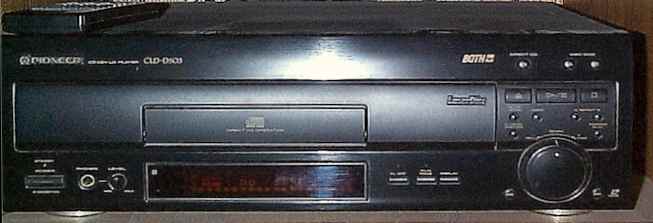
The
Operation Manual for the CLD-D503. Pioneer
CLD-D503
Playback Functions:
Program Playback
Random Playback (For LDs, this function is available with only discs
containing TOC.)
Repeat Playback
Hi-Lite/Intro Scan Playback
Hi-Lite Scan - CD, CDV-audio part
Intro Scan - LD, CDV-video part
Auto Program Editing/Compu Program Editing
LD (LaserDisc) Playback Functions:
Gamma-Turn System - Two-Side Continuous Playback
A Side <-<>-> B Side Continuous Playback Programs
Last Memory Function
CD (Compact Disc) / CDV (Compact Disc with Video) Playback Functions:
Direct CD Function
Other Features:
1-Bit DLC D/A Converters
Auto Loading and Automatic Disc Discrimination Functions
Compatibility with Many Discs Types and Sizes
Film Mode
Digital Level Control Using SCAN Control Adjustment
Ouputs:
2 Sets of A/V Pin-Type Outputs
1 S-Video Output
Pioneer CD-Deck Synchro Function |

James Bond
Materials© 1962 - 2017 United Artists Corporation and Danjaq, LLC. 007 Gun
Logo© 1962 United Artists Corporation and Danjaq, LLC. 007 Gun Logo, Iris
Logo,
JAMES BOND and all other James Bond related trademarks - Danjaq, LLC. All
Rights Reserved. Copyright



 .
.